About Iris mariae Barbey
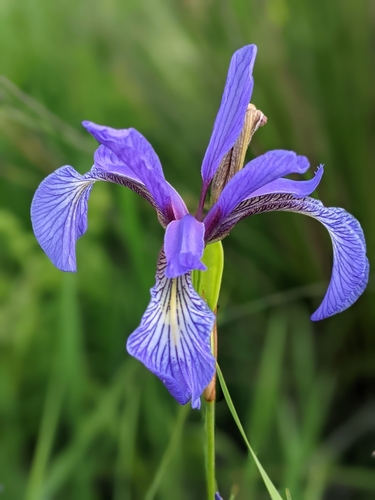
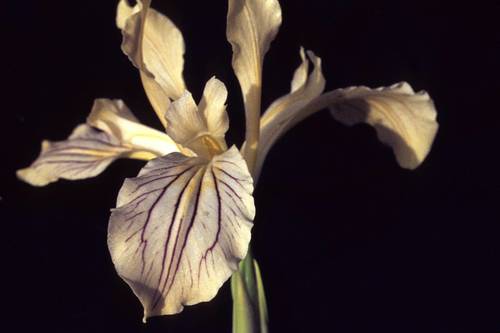
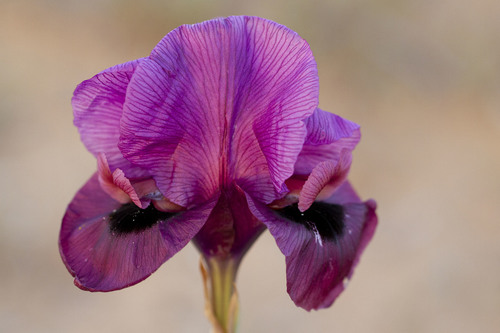
Iris mariae Barbey is a geophyte with a short, around 3 cm long rhizome. It is stoloniferous, meaning it produces several extremely long secondary roots. It has 7 to 8 glaucous, sickle-shaped (falcate) leaves, which are 10 to 12 cm long and 0.4 to 0.6 cm wide. These leaves are very similar to those of Iris iberica. The stem of Iris mariae can grow 15 to 25 cm tall, which is taller than its foliage. It flowers in late spring, between February and March. Its large flowers have a diameter of 8 to 10 cm, and come in shades of lilac, pinkish, or violet. Flowers have two pairs of petals: three large outer sepals called 'falls', and three smaller inner petals (or tepals) called 'standards'. The falls are recurved, darker, 5 cm long and 2.5 to 3 cm wide, marked with reddish brown or dark purple veining, and have a blackish-violet or deep purple signal patch. In the middle of the falls there is also a row of short hairs called the 'beard', which is black or purple. The upright standards are larger and paler than the falls, 6 to 6.5 cm long and 4 cm wide. After flowering, the plant produces a seed capsule. Iris mariae is native to temperate Asia, and is endemic to Israel and Egypt. In Israel it is found in the Negev Desert, including Tze'elim and the Palestine region. In Egypt it occurs on the Sinai Peninsula. In the 2006 IUCN Red Data Book, Iris mariae is listed among 6 threatened plant species found near Lake Bardawil, Egypt, alongside Astragalus camelorum, Bellevalia salah-eidii, Biorum oliveri, Lobularia arabica and Salsola tetragona. It grows in sandy semi-desert or desert habitats, specifically in stable sand dunes and loessial sand in areas that receive 100 to 200 mm of annual precipitation, growing alongside Artemisia monosperma. Like many other irises, most parts of Iris mariae (especially the rhizome and leaves) are poisonous. If mistakenly ingested, it can cause stomach pains and vomiting. Handling the plant may also cause skin irritation or an allergic reaction. In cultivation in Europe, it is hardy to Zone H4, which corresponds to hardiness between -5 to -10 °C (23 to 14 °F) and down to −20 °C (−4 °F). It typically requires very good drainage, limited water, and protection from frosts, though keeping it barely dry during winter increases its cold tolerance. Its seeds are considered easy to germinate, but growers are recommended to have prior experience growing other irises in this group. Its seeds can also be grown via in-vitro germination. In 1970, Israel issued a 'Israeli Wild Flowers' stamp series for Independence Day that featured Iris mariae. In February 2013, an ATM Label Negev Iris featuring an image of the iris was produced.