About Iris laevigata Fisch.
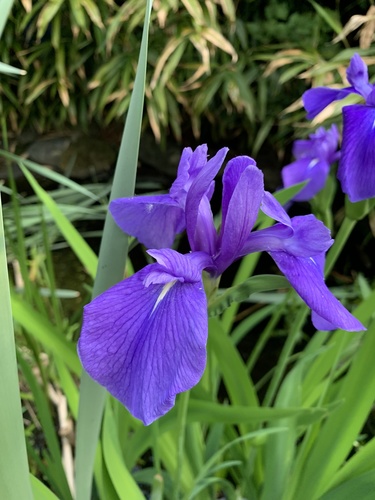
Iris laevigata, commonly called Japanese iris, rabbit-ear iris, or shallow-flowered iris, known as kakitsubata in Japanese, is a flowering plant species in the Iridaceae family. It is native to Japan, and is related to other members of Iris subgenus Limniris, including other Japanese iris species.
It naturally grows in shallow water, and prefers marshy areas and still ponds, but can also be cultivated successfully in damp soil when growing conditions are suitable. Its flowers are most often blue, purple, or violet, and display distinctive color patterns. Specific known varieties include washino-o, which bears mostly white flowers with blue spots, and maikujaku, which has dark purple flowers edged in white. Its scientific synonyms are Iris albopurpurea and Iris phragmitetorum.
In cultivation, Iris laevigata differs from other Japanese irises primarily by its higher water requirement, and the absence of a strong midrib on its foliage. When grown from seed, it typically germinates between 30 and 545 days, and germination can be inconsistent even under ideal conditions. To grow from seed, sow seeds approximately 6 mm deep in a peaty seed sowing mix kept at 15 to 20 °C, with frequent watering. Some varieties are nearly continuous-blooming even in mild climates, making this species a good choice for water gardens in temperate regions. This plant has been cultivated in Japan for over a thousand years, and some varieties recorded in Japanese gardening texts from the late 17th century are still grown today. The variegated cultivar Iris laevigata 'Variegata' has received the Royal Horticultural Society's Award of Garden Merit.