About Iris lacustris Nutt.
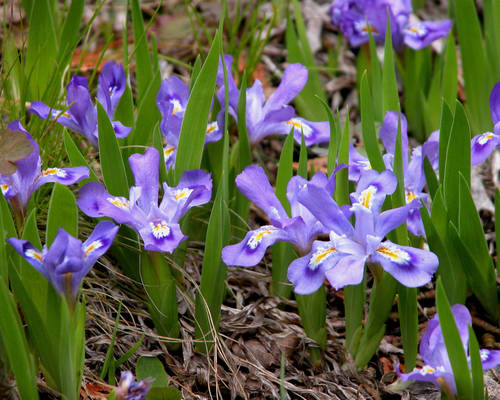
Iris lacustris Nutt. is similar in form to Iris cristata, but is chromosomally distinct and smaller. It has slender, wiry or cord-like rhizomes that are greenish-brown or yellow. The rhizome has a large central section plus outer sections that are 3–5 cm (1–2 in) long and 0.8–1.2 cm wide. Underneath these outer sections grow fibrous roots, and 2–3 brown scale-like leaves grow above. The rhizome creeps across the ground, forming thick clumps of plants. The plant produces 8–12 sheathing, fan-like, green or light green basal leaves. These leaves are falcate (sickle-shaped) or sword-shaped, linear, 4–6 cm long and 8–10 mm wide. After flowering, the leaves elongate to reach 15–16 cm long and 10 mm wide. When the plant is not in flower, its leaves can be confused with Triantha glutinosa (false asphodel), a white-flowered lily family member that grows in similar habitats. False asphodel has much narrower leaves, a much longer flower stem than Iris lacustris, and its flower stem is very sticky. Iris lacustris has very short stems, measuring 0.8–5 cm long. Both its stems and flowers are shorter than its leaves. It has green flower bud leaves (spathes) that are slightly keeled, 3–4.5 cm (1–2 in) long, with scarious (membranous) edges. Each short stem bears 1 to 2 flowers, which bloom in spring or summer (April, May, early June, or July; summer blooming occurs in Europe). In spring, it can flower 7 to 10 days earlier than Iris cristata, and may produce a later flush of flowers in fall (October). The flowers are 4–6 cm in diameter, and come in shades of blue, violet-blue, sky blue, deep blue, lavender blue, lilac, or deep purple. A white-flowered form is occasionally found. Like other irises, it has 2 pairs of floral parts: 3 large outer sepals called 'falls' and 3 smaller inner petals (or tepals) called 'standards'. The falls are obovate, 2–2.3 cm long and 0.8 cm wide, and taper toward the claw (the section closest to the stem). They have a white signal patch with a deep violet margin, plus 3 central, orange, gold, or yellow and white toothed (fimbriated/fringed) ridges (crests). The signal patch guides bumblebees into the center of the flower to pollinate it. The standards are narrowly oblanceolate, 1–1.5 cm long and 0.4–0.5 cm wide, and are shorter and narrower than the falls. It has a yellow, funnel-like perianth tube that is 1–2 cm long, shorter than the perianth tube of Iris cristata. It has a trigonal (triangular) ovary that is 0.8–1 cm long. It has a 1–2 cm long style with linear crests and wavy (crenate) edges; the style arm guides bumblebees to the lower section of the sepal to reach nectar. After flowering, between late June and late July, it produces a roundly triangular or ovoid seed capsule that remains covered by the spathes. The capsules are 1.2 cm long and 8 mm wide. Inside the capsule are dark brown seeds 3 mm wide, which have a white fleshy seed coat appendage (aril) spiralled around the seed. This corkscrew-like appendage is called an elaiosome, which ants use as an energy-rich food source, and ants help disperse the plant's seeds. Iris lacustris is native to temperate regions of North America. It is found in Canada's Ontario province, on the Bruce Peninsula and Manitoulin Island. In the United States, it occurs in the states of Michigan and Wisconsin. It grows along the northern shores and smaller islands of Lake Michigan and Lake Huron, in the Great Lakes region. Most populations of the iris are within 500 m of the shore, though the largest populations can occur several kilometers away from the lake. It grows near Great Lakes shorelines in cool, moist lakeside air, or in limestone glades. It is found on sand, in thin soil over limestone-rich gravel, in calcareous (chalky) soil, or on bedrock. It also grows on alvar limestone barrens, along shorelines, old beach ridges, beside streams, in ditches, on cliffs, behind open dunes, or at the edges of coniferous woods (in Canada and Michigan). Like many other irises, most parts of this plant (the rhizome and leaves) are poisonous. Accidental ingestion can cause stomach pains and vomiting, and handling the plant may lead to skin irritation or an allergic reaction. It is hardy between USDA Zone 4 and Zone 7, and European Zone H2, and is hardy in Europe and the United Kingdom. It tolerates a range of soils, but prefers moist, slightly acidic to neutral soils. It flowers mostly in semi-open habitats with partial sun, though it can also tolerate sunny sites. It can grow in a peat bank, or be grown in a six-inch pot or similar container. It is rarely offered for sale in Europe, and a specimen has been grown at Cambridge Botanic Garden.