About Iris lactea Pall.
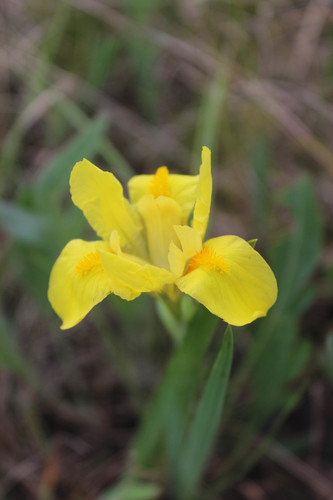
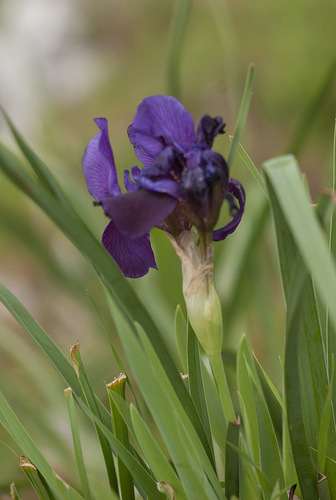
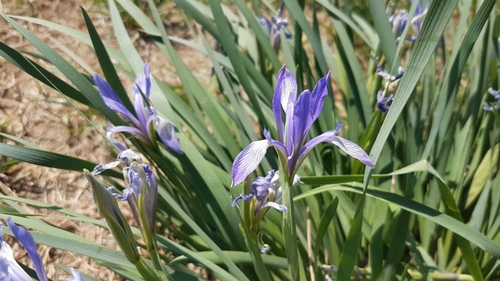
Iris lactea Pall. has a thick creeping rhizome covered in reddish purple fibres. It reaches 3–50 cm (1–18 in) in height, with a 10–30 cm (4–12 in) long flowering stem. Each stem produces 2–4 flowers, which bloom between April and June, or between May and August in the UK. The violet-scented flowers measure 5–7.5 cm in diameter and last for 2–3 weeks. Flower colors range from pale blue to violet, and can also be white or yellow. It has green, lanceolate (lance-shaped) spathes measuring 4.5–10 cm by 0.8–1.6 cm. It has dark flower standards and delicate white falls striated with blue, red-purple or violet. The flower stalks (pedicels) measure 4–7 cm long, it has a very short perianth tube (3 mm), 2.5–3.2 cm long stamens, and yellow anthers. Its leaves are linear, mostly ribbed, greyish green, and grow from the base of the plant. The leaves are 14–70 cm long and 3–7 mm wide. After flowering, it produces seeds between June and September. The seed capsule is narrow and cylindrical, with 6 ribs running along its sides, and ends in a beak-like point. The capsule measures 6.5–7.5 cm by 1–1.4 cm. Fruiting stems are unequal in length, ranging from 4–10 cm. Inside the capsule are maroon-brown, pear-shaped (pyriform) seeds.
This iris is native to temperate and tropical regions of Asia across a wide range of areas. It can be found in Afghanistan, Kashmir (including Guraiz and Himachal Pradesh), Kazakhstan, Central Asia, India (including Ladakh), Pakistan, Russia (Siberia and Primorye), Tibet, China, Mongolia, and Korea. In China, it occurs in the provinces of Anhui, Gansu, Hebei, Heilongjiang, Henan, Hubei, Jiangsu, Jilin, Liaoning, Nei Mongol, Ningxia, Qinghai, Shaanxi, Shandong, Shanxi, Sichuan, Xinjiang, and Xi-zang (Chinese Tibet). It is counted among the species found in the Altai-Sayan region, where Russia, China, Mongolia, and Kazakhstan meet, alongside Iris bloudowii, Iris humilis, Iris ruthenica, Iris sibirica, Iris tenuifolia, and Iris tigridia. It is considered a wildflower in India and China.
Iris lactea grows in a wide variety of habitats, including steppe meadows, turf slopes, heavily grazed river shores within desert steppe, grasslands, roadsides, grassy slopes, and hillsides. It grows at altitudes between 600 and 3800 m above sea level, and can bloom as late as late summer in the wild.
As one of the most common wild irises across China, found in diverse habitats, Iris lactea is very tolerant of most garden conditions. It is hardy to USDA Zones 3–9. It grows well in a variety of soils, including soils that dry out in summer, tolerates salty areas, and can act as a soil improver. It prefers sunny locations but can also grow successfully in shade. It has been planted in large stands on high-lead soils to reduce lead contamination. It is well-suited for cultivation in rock gardens and for group plantings.
It is widely grown across China, where it is often used as an ingredient in herbal contraceptives. It is also a source of the anti-cancer drug Irisquinone, derived from a herbal remedy. Its rhizomes are used in traditional oriental medicine, including traditional Tibetan medicine. Its leaves are used as animal fodder, and for thatching, matting, and basket work; leaf fibres from the plant are also used to make paper and brushes. The flowers contain the pigment anthocyanin. It is also used in veterinary medicine: consuming the flowers and seeds is thought to increase a cow's milk yield.