About Iris japonica Thunb.
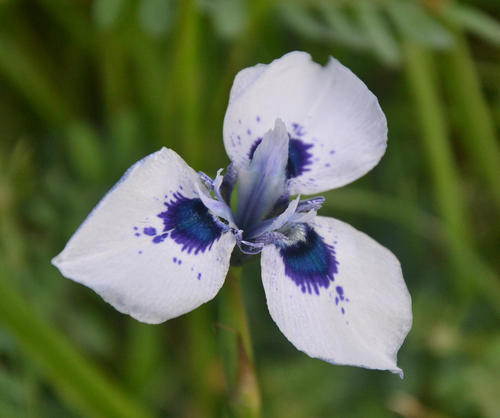
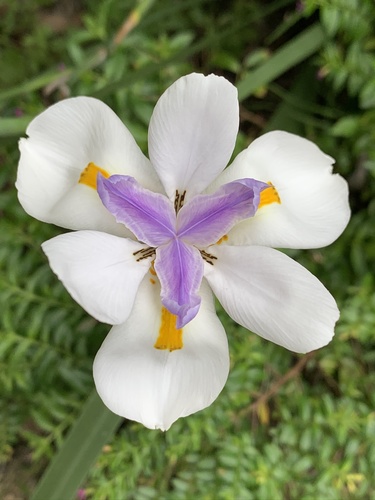
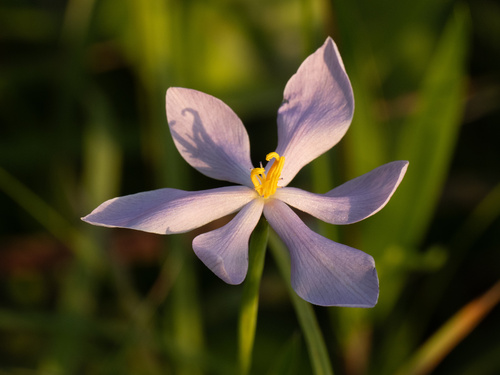
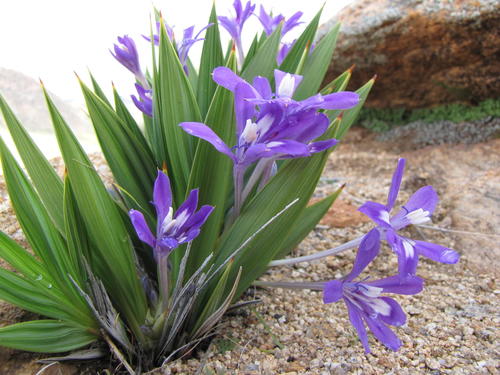
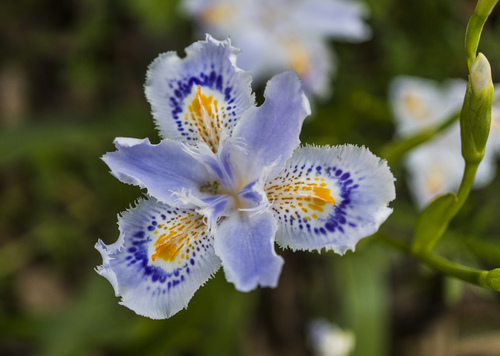
Iris japonica Thunb. is similar in form to Iris confusa, but its leaves grow at ground level. It has short, slender, greenish, creeping rhizomes and spreads via long, thin, wiry stolons. It is shallow-rooted, forms dense carpets and clumps, and is not invasive. Its basal leaves can be deep green, dark green, yellowish green, or light green; they are glossy or shiny on one side and dull on the other, tinted reddish purple near the rhizome, and lack a midvein. These lance-shaped leaves grow 25–60 cm (10–24 in) tall and 1.5–3.5 cm wide. Generally evergreen, they grow in a broad fan with arching tips. It has wiry, stout stems that can reach 25–80 cm (10–31 in) tall. There are 5–12 short, slender flower-bearing branches (pedicels) near the top of the plant; these stiff pedicels are 1.5 to 2.5 cm long, and the flowering stem and its branches grow taller than the leaves. Stems bear 3–5 lanceolate spathes (flower bud leaves) that range from 2.2 to 9.5 cm long. Stems and their multiple branches hold between two and four flowers, which bloom in spring and early summer: between March and April in Japan, or April and May. The flowers resemble Iris cristata flowers but are paler and more elaborate. Short-lived, flowers open in succession over 2 to 5 weeks, and carry a clove pink aroma. The flattish flowers are 4.5–6 cm in diameter, and come in shades ranging from pale blue, pale lavender, lilac, or purple to white. Like most irises, it has two pairs of petals: three large outer sepals called 'falls' and three smaller inner petals or tepals called 'standards'. The falls are elliptic or obovate, with a spreading limb and blue or purple/violet blotches, spots, or dots around a central yellow signal patch surrounding a visible yellow or orange crest. They are 2.5–3 cm long and 1.4–2 cm wide. The standards are elliptic or narrowly obovate, 2.8–3 cm long and 1.5–2.1 cm wide. The standards spread on the same plane as the falls, creating the flower's characteristic flat look. All petals have fringed edges. It has a 1.1–2 cm long perianth tube, 0.8–1.2 cm long stamens, white anthers, a 7–10 mm ovary, and 0.5–0.75 cm long pale blue style branches; the terminal lobes of the style branches are also fringed. After flowering, between May and June, it produces an ellipsoid-cylindric, non-beaked seed capsule that is 2.5–3 cm long and 1.2–1.5 cm wide. Inside the capsule are dark brown seeds with a small aril. It is native to temperate and tropical regions of Asia. As Japanese populations of Iris japonica are triploid, they do not produce seeds, so all habitat expansion of the species in Japan is thought to be artificial. While it can be found in seemingly wild Japanese woodlands, its presence often indicates the area was previously inhabited by humans and later abandoned. It is found in the Chinese provinces of Anhui, Fujian, Gansu, Guangdong, Guangxi, Guizhou, Hainan, Hubei, Hunan, Jiangsu, Jiangxi, Qinghai, Shaanxi, Shanxi, Sichuan, Tibet, Yunnan, and Zhejiang. In Japan, it occurs on the islands of Honshu, Shikoku, and Kyushu. In tropical Asia, it grows in Myanmar (Burma). It was first found in Mongolia in 2014. Iris japonica grows on forest margins, in wet grasslands or meadows, among rocks by streams, and along hillsides or rocky slopes. In Japan, it occurs at altitudes of 500 to 800 m (1,600 to 2,600 ft) above sea level; in China, it grows at 2,400 to 3,400 m (7,900 to 11,200 ft) above sea level. Like many other irises, most parts of Iris japonica (especially the rhizome and leaves) are poisonous. Accidental ingestion can cause stomach pains and vomiting, and handling the plant may trigger skin irritation or an allergic reaction. Iris japonica is very common in cultivation in the United States, and it is the most commonly cultivated crested iris in the United Kingdom. It is hardy to USDA Zones 7 to 10, and to European Zone H3. It grows very easily in sheltered positions in Mediterranean climates. Within the UK, it is hardy in Devon and Cornwall, as well as some other parts of southern UK, and prefers the protection of a sheltered sunny wall. Some cultivars of Iris japonica are hardier than others. However, extremely cold winters or late frosts can negatively affect this species' flowering, and cause foliage to become tatty or browned. It should be grown in well-drained soils, and moist soils are preferred. It can tolerate neutral or acidic soils with pH between 6.5 and 7.8, though it prefers slightly acidic soils, including peat banks. It cannot tolerate salty water. It has average water needs during the growing season; wet or damp conditions over winter can cause root rot. It can grow in positions ranging from full sun to partial shade, but prefers partial shade. It can be grown in a mixed flower border, as a ground cover, or in containers in sheltered positions. Stems and dead leaves should be removed after flowering to keep the plant tidy and support healthy growth the following year. In frost-prone areas, it can be grown in a cool greenhouse; plants are rested in summer after spring flowering, and restarted in late autumn. If grown outside a cool greenhouse, it should be placed in a sheltered position among shrubs, where it is protected from morning sun. It has no serious disease or insect problems, but pests such as thrips, slugs, and snails occasionally damage plants by feeding on flowers or foliage. The aphid Aulacorthum magnoliae can be found on this plant, and it can be susceptible to attack by Japanese beetle. In Japan, Iris japonica is used as a source of starch; rhizomes are ground up to extract the starch. In China, its rhizome is used in herbal medicine to treat injuries; as a decoction, it is used to treat bronchitis, internal injuries, rheumatism, and swellings. Historically in Japan, Iris japonica was planted on hilltops within castles: the slippery fan-shaped leaves slowed invading marauders to let defending armies protect the castle.