About Iris humilis Georgi
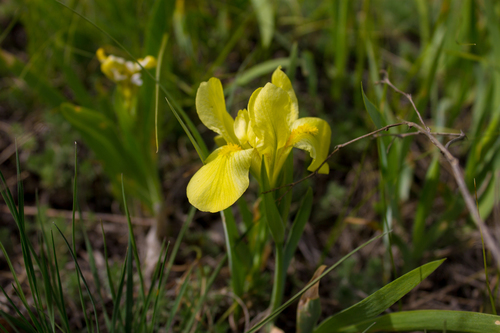
Iris humilis Georgi is very similar in form to Iris mandshurica, another Psammiris species which has leaves that curve to one side, but Iris humilis is a shorter plant. It has a thick, creeping, branched rhizome about 1 cm in diameter. The top of the rhizome holds the remains of last season’s leaves. It produces basal leaves that are bluish-green, gray-green, or light glaucous green, and shaped like a sword or lance. These leaves can grow 5–10 cm (2–4 in) long and 0.2–0.7 cm wide, have incurving tips, and die back in summer after flowering. It has a simple, short dwarf stem that grows 5–25 cm (2–10 in) tall. The stems hold 2–3 lanceolate spathes (flower bud leaves), which are membranous (scarious) at the leaf tip. It has short flower stalks (pedicels) 7.5mm long. Stems bear between 1 and 3 flowers in late spring, from April to June. Individual flowers only last for one day, but the plant will sometimes produce new blooms sequentially. The vanilla-scented flowers are 3–4 cm (1–2 in) in diameter, and come in shades of yellow including bright yellow. Flower buds are normally green, with a faint bronze tinge. Like other irises, it has 2 pairs of petals: 3 large outer sepals called 'falls' and 3 smaller inner petals/tepals called 'standards'. The falls are oblong-shaped, 35 mm (1 in) long and 1.2 cm wide, marked with brown or purple-brown veins, and have a central orange beard. The shorter standards are 30 mm (1 in) long and 0.3 cm wide. They do not grow erect, which gives the flower a flattish overall appearance. It has a 1 cm long ovary and a 0.5 cm long, funnel-shaped perianth tube. Its styles, about 2.5 cm long, are shorter than the petals, and have short narrow crests. The anthers are cream with green-black edging, and the pollen is greenish. After flowering, it produces an elliptical seed capsule around 3 cm long in August. The capsule splits open (dehisces) below its apex. Inside the capsule are wrinkled, light brown or brown, pear-shaped (pyriform) seeds with a flat creamy-white appendage called an aril. It is native to a large range across temperate regions of Asia and Europe. In Europe, it has been recorded in Austria, former Czechoslovakia, Hungary, and Romania, though some or most of these records may actually refer to Iris arenaria, another species found across central and eastern Europe. In the Russian Federation, it is found in the Siberian region, in the areas of Buryatia, Chita, Irkutsk, Magadan, Primorye and Tuva, and it also occurs in Kazakhstan. Within Asia, it is found in the Chinese provinces of Heilongjiang, Jilin, Nei Monggol, Ningxia and Xinjiang, as well as in Mongolia and Japan. It occurs alongside Iris glaucescens, Iris lactea, Iris ruthenica, Iris sibirica, Iris tenuifolia and Iris tigridia in the Altai-Sayan region, where the borders of Russia, China, Mongolia and Kazakhstan meet. It grows in calcareous sandy and stony or rocky areas, including mountain and hill slopes, meadows, steppes, the edges of birch or pine forests, and beside river banks. It can be found at altitudes between 200–1,500 ft (61–457 m) above sea level. Like many other irises, most parts of the plant (especially the rhizome and leaves) are poisonous. If mistakenly ingested, it can cause stomach pains and vomiting. Handling the plant may also cause skin irritation or an allergic reaction. It is hardy between USDA Zone 1 and Zone 6, and is cold resistant, as it survives naturally in Siberia. It prefers to grow in well-drained soils, and favors soils that contain sand. It can tolerate mildly acidic or mildly alkaline soils, with pH levels between 6.1 and 7.8, including soils that contain lime. It can grow in positions with full sun or partial shade. It has average water needs during the growing season. Its leaves can be damaged by rust fungi. It can be grown in rock gardens, including rock screes, but needs plenty of growing space. It is rarely cultivated in the UK. To grow it successfully in the UK, William Rickatson Dykes recommends planting the iris on a 5 cm layer of sand, placed over garden soil amended with leaf mould or compost. It was first grown in gardens near Moscow in 1812, and was later trialed at botanic gardens in St. Petersburg, Barnaul, Novosibirsk and Chita. In Tibetan traditional medicine, its rhizomes are used to regulate menstruation. Powdered rhizome is used to treat sepsis and infections.