About Iris haynei Baker
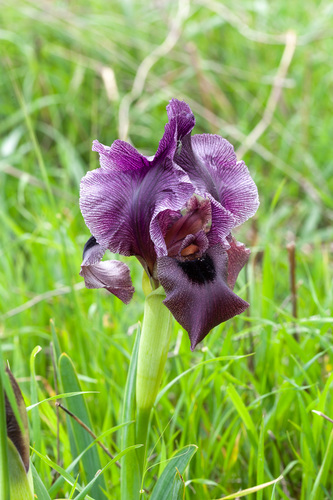
Iris haynei Baker is a geophyte with a stout rhizome and small brown stolons that grow below ground, forming clumps of plants. It produces 5 to 8 smooth, linear or lanceolate, greyish-green leaves that grow up to 25–30 cm (10–12 in) long and 1 to 1.5 cm wide. The leaves emerge in spring and fade after summer. A slender stem (or peduncle) grows 40–60 cm (16–24 in) tall, holding flowers high above the foliage. It bears terminal (top-of-stem) fragrant flowers that bloom in spring between March and April. The flowers measure 10–12 cm (4–5 in) in diameter, and come in shades of deep purple, violet, purple, brownish purple, or dusky lilac, usually with veining or spotting over a pale or pale pink-violet background. Like other irises, it has 2 pairs of petals: 3 large outer sepals called falls, and 3 smaller inner petals (or tepals) called standards. The oblong or ovate, rounded, recurved (bent backwards) falls are 7–8 cm long and 4–6 cm wide, and are more densely veined and spotted than the standards. The incurved (bent forwards) standards are 9–10 cm long and 6–7 cm wide. In the centre of the falls sits a dark purple, black-brown to blackish signal patch, and a row of short hairs called a beard that varies in color from dark purple, white, or dark-tipped yellow. A semi-albino form with white-yellowish or golden yellow flowers and a dark red signal patch has been recorded. It has a 2.5 cm long perianth tube. After flowering, it produces a loculicidal seed capsule (with internal chambers), and the seeds inside can delay germination for up to several years, allowing new plants to grow after periods of drought. Iris haynei is native to temperate Western Asia, and is endemic to the Samaria region of northeastern Israel and Palestine and northwestern Jordan. Its range includes the Lower Galilee (including Mount Tabor), the Bisan Valley of the Emek HaMaayanot Regional Council, and Mount Gilboa. Small populations can also be found in the Judaean Desert, near the kibbutz of Ein Gev on the Sea of Galilee, and in the northern West Bank, where it crosses the adjacent West Bank barrier. It grows in Mediterranean woodlands, shrublands, and on rocky hillsides, found on soils containing limestone and dolomite, or at the edges of fields in terra rossa, at altitudes of 150–550 m (490–1,800 ft) above sea level. Like many other Oncocyclus iris species, Iris haynei is pollinated by night-sheltering solitary male eucerine bees, which are attracted to the heat reward provided by its dark flowers. Unlike in Iris atropurpurea and Iris gracilipes, where large flower size provides an advantage in attracting pollinators, larger flower and plant size in Iris haynei does not give a pollination advantage over smaller species such as Iris tuberosa. Like many other irises, most parts of Iris haynei (particularly the rhizome and leaves) are poisonous. Accidental ingestion can cause stomach pains and vomiting, and handling the plant may trigger skin irritation or an allergic reaction. As a member of the Oncocyclus Section of irises, it is easier to cultivate than irises of the Regelia Section. In general, it requires good drainage, minimal summer rainfall and dry winters, similar to a semi-arid climate. In temperate regions such as Europe and North America, it is only suitable for cultivation by specialist iris growers, grown in a bulb frame or greenhouse. Growing under glass in frames protects the plants from excess moisture, especially during winter, and ensures shallow-planted rhizomes receive optimal temperatures during the growing season. It can also be grown in pots, particularly deep pots called long toms, but requires re-potting every 2 years and additional feeding. Watering is one of the most critical aspects of its cultivation, and it can be affected by aphids, viruses, and rots.