About Iris halophila Pall.
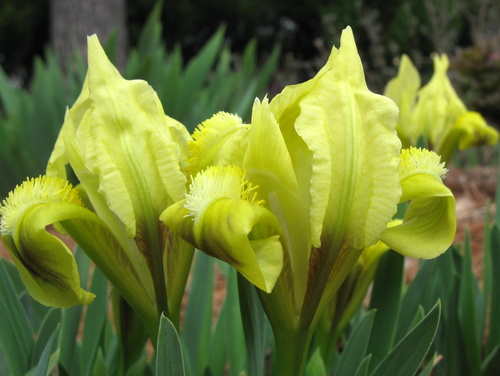
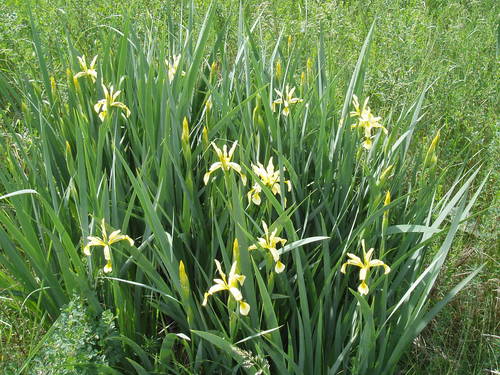
Iris halophila Pall. is similar in form to Iris orientalis, but shorter. It has stout, thick purple-brown rhizomes 1.3–3 cm in diameter. Thick roots grow beneath the rhizomes, which spread along the ground in a creeping habit. It produces greyish-green, linear, erect, sword-shaped leaves that grow 20–60 cm (8–24 in) long and 0.7–2 cm wide. The leaves do not have a mid-vein, and foliage can sometimes be longer than the flowering stems. Similar to Iris spuria, bruised leaves of this species produce an offensive smell. It has a smooth 40–90 cm (16–35 in) long flowering stem with 1–4 very short lateral branches. Stems hold 3–8 total flowers (3–4 per stem, at the top of the stem) in early summer, between May and June. Its lanceolate spathes are membranous at the top, 5.5–9 cm (2–4 in) long and 2 cm wide. Flowers are 5–7 cm (2–3 in) in diameter, and range in colour from white and yellowish to grey-purple and violet. Flowers have 2 pairs of petals: 3 large outer sepals called ‘falls’, and 3 smaller inner petals (or tepals) called ‘standards’. Falls are fiddle-shaped, with a narrow section between the claw (the section closest to the stem) and the outer limb or blade. The claw is 2–3 cm long and 0.5 cm wide, while the oblong or rounded limb is 1.5 cm long and 1 cm wide; the limb normally bends downwards. Standards are erect, oblanceolate, 3.5 cm long and 6–8 mm wide. Pale to dark yellow forms with darker veining noted by some references are actually Iris spuria subsp. halophila (Pall.) B.Mathew & Wendelbo. Iris halophila has a 1.5–3 cm long pedicel, a short 1 cm long perianth tube, 3 cm long stamens, yellow anthers, and a 3.5–4 cm long ovary. Its style branches, which are white or yellow depending on petal colour, are 3.5 cm long and 6 mm wide, and match the length of the petal claws. After flowering, the plant produces a greenish brown, ellipsoid-cylindric seed capsule between July and August. Capsules measure 6–9 cm (2–4 in) long and 2–2.5 cm wide, have ridges and a beak at the top, and normally grow in pairs. Inside the capsules are pyriform (pear-shaped), paper-like seeds with a glossy or wrinkled (rugose) yellowish maroon seed coat (testa). This species is found in Germany, Romania, and Ukraine in Europe; in Kyrgyzstan and Uzbekistan (former Soviet Union Central Asian republics); and in Iran (also called Persia), Pakistan, Afghanistan, and the Caucasus region of Russia. It also occurs in Siberia, Mongolia, and West Asian regions, and in China it is found in the provinces of Gansu and Xinjiang. It grows on wet grasslands or meadows, on hillsides, beside rivers, and on wet salty soils or salt marshes. It is hardy to −25 °C, and loses most of its leaves in winter, leaving only a few short leaf tips. It prefers moist, heavy soils but can tolerate most other soil types, and grows best in full sun positions. It is very hardy, produces seed very readily, and will readily grow in areas where more delicate plant species have died out. It is best planted between August and September. In Chinese herbal medicine, it is used to treat hematochezia and various other conditions. A research specimen of Iris halophila is held in the Linnean Society of London herbarium.