About Iris graminea L.
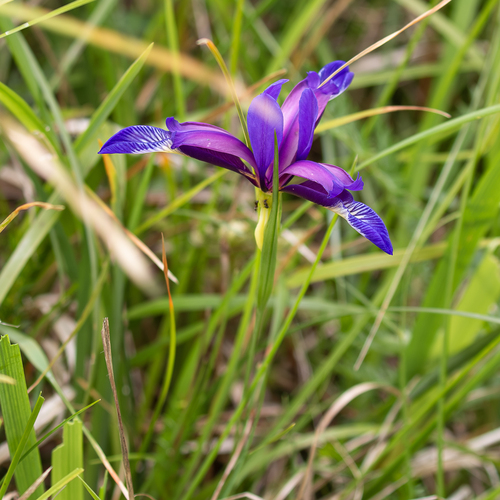
Iris graminea L. has hard, slender rhizomes and narrow, grass-like foliage. Foliage grows 30–100 cm (12–39 in) long and 0.5–1.5 cm wide. Multiple branches can form dense tufts, clumps, or tussocks of plants. Leaves are shiny green, longer than the flowering stems, and have clearly visible longitudinal veins. After flowering, the foliage tends to extend. As a deciduous plant, its foliage dies back completely over winter. The plant produces a flattened stem that grows 10–60 cm (4–24 in) long. Stems normally do not branch, and bear 1–2 unequally sized spathes; the lower spathe is larger and rather leaf-like. Stems hold 1–2 terminal flowers at the top of the stem, which bloom between May and spring to summer. The pedicel can grow up to 6 cm long. Flowers have two pairs of petals: three large sepals called ‘falls’, and three inner tepals called ‘standards’. Falls have a long haft (the section closest to the stem), and a small rounded or oval blade, measuring 3–5 cm (1–2 in) long. The center of the blade has a pale yellow or white central area, which is veined with violet, purple, or blue. The claw of the fall is sometimes winged, tinged with green or brown, or veined with deep reddish-purple. The species has an ovary with double ridges and a short perianth tube. After flowering, it produces a 3–4 cm (1–2 in) long seed capsule that holds pear-shaped, slightly compressed and flattened seeds. Like most irises, Iris graminea is diploid, with two sets of chromosomes, a trait that can be used to identify hybrids and classify iris groupings. This species is native to temperate regions of Europe and Asia, and is widespread from Spain to Russia. In Asia, it occurs in the Caucasus and Turkey. In Europe, it can be found in Western, Southern, and Eastern parts of the continent. It typically grows in scrubland, grasslands, meadows, open woods, and on mountains in rocky or gravelly soils. Iris graminea is hardy in USDA Zones 3 through 9, and European Zone H2. It can survive temperatures as low as −20 °C. Over winter, foliage dies back, leaving rhizomes underground. In very cold climates, a layer of mulch can help the plant survive the winter. It can be grown in normal garden conditions. It prefers neutral to slightly acidic, well-drained, fertile soils. While it tolerates dry, clay, or heavy soils, it prefers damp soils. It grows best in full sun positions, and can tolerate partial shade. It requires adequate watering during growth: conditions should be moist in spring, and drier through summer. It has no serious insect or disease problems. Crown rot is an uncommon disease issue. It can be susceptible to certain viruses, bacterial leaf blight, soft rot, rhizome rot, leaf spot, rust, and scorch. It can also suffer damage from insects including flies, weevils, moths, thrips, slugs, snails, aphids, and nematodes. This plant has been cultivated in gardens since at least 1568. It was first grown at Cambridge Botanic Garden in 1733, where it was labelled as the narrow leafed plum scent iris. It was also grown for many years at St. Petersburg Botanical Garden, and the botanical garden of Ufa.