About Iris glaucescens Bunge
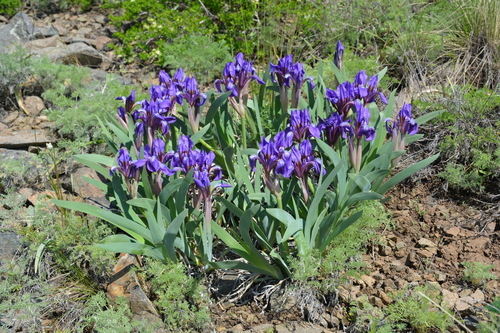
Iris glaucescens Bunge has a thick, nodular rhizome up to 3 cm thick, with fibrous remains of the previous season’s leaves on top of the rhizome. It produces falcate (sickle-shaped) leaves that are blue-grey or grey. It has a slender stem that grows between 8–25 cm (3–10 in) tall. This height is similar to that of Iris scariosa, and the stem exceeds the height of the plant’s own leaves. The stem bears scarious (membranous) spathes, which are modified leaves surrounding the flower bud, that are 5–15 cm (2–6 in) long with long keels. Each stem holds 2 terminal flowers that bloom from mid to late spring, between April and May. The flowering period lasts an average of 12 days. The flowers are 3.5–5.5 cm (1–2 in) in diameter, and can range in shade from blue-violet, pale violet, lilac-purple, deep purple, and light bluish to almost white. Like other irises, it has 2 pairs of petals: 3 large outer sepals called 'falls', and 3 smaller inner petals (or tepals) called 'standards'. It also has white beards on its falls. After flowering finishes in midsummer, it produces a fusiform (spindle-shaped) seed capsule. Inside the capsule are wrinkled, dark brown, globular seeds, that measure 4–5.5 mm long and 2–3 mm wide. This species is native to Middle and Central Asia. There is uncertainty about which areas Iris glaucescens is endemic to, because it has been merged with the very similar Iris scariosa, which shares a broadly similar range though Iris scariosa is only found near the Caspian Sea and Caucasia. Iris glaucescens has been recorded in Russia (within Siberia, near Barnaul), China, Mongolia, and Kazakhstan (from north of the Aral Sea to the east of Lake Balkhash). It was also found in the former Russian Turkestan khanates of Bukhara and Khiva, which are now part of Uzbekistan. It occurs alongside Iris biglumis, Iris bloudowii, Iris ruthenica, Iris sibirica, Iris tenuifolia and Iris tigridia (another Pseudoregelia iris) in the Altai-Sayan region, where Russia, China, Mongolia and Kazakhstan meet. It grows on mountain steppes, rocky slopes, and sandy areas, and can be found at altitudes up to 2,700 m (8,900 ft) above sea level. Like many other irises, most parts of this plant (including the rhizome and leaves) are poisonous. If mistakenly ingested, it can cause stomach pains and vomiting. Handling the plant may also lead to skin irritation or an allergic reaction. It is hardy between USDA Zone 2 and Zone 3. Its hardiness was tested in Russia at the botanical gardens of Barnaul, Novosibirsk, and St. Petersburg, where it survives winter without shelter, and Ufa, where it produces viable seeds. It has proven difficult to cultivate, because it requires hot summers and dry winters. It prefers to grow in well-drained sandy soils. It can be grown in rock gardens, or used as an early spring plant in perennial borders. It does not tolerate waterlogged soils, which can cause its rhizomes to rot. It is rarely available for cultivation.