About Iris giganticaerulea Small
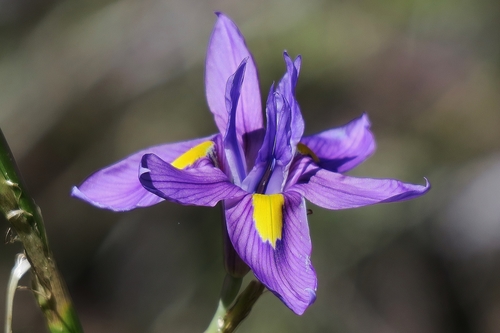
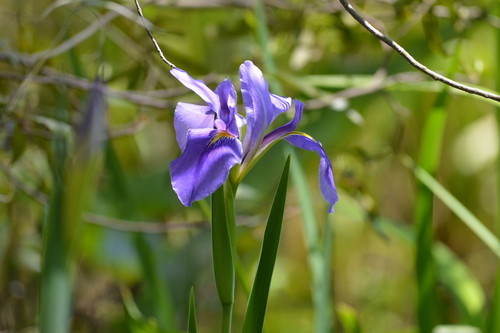
Iris giganticaerulea, commonly known as the giant blue iris, is the largest species of Louisiana irises. It produces very large green rhizomes that measure 5 to 12 inches (13–30 cm) long and 0.75 to 1.5 inches (2–4 cm) thick. These rhizomes root shallowly in the ground, are marked with scars from previous seasons' leaves, have many branches, and can form large clumps or colonies that grow up to 6 x 3 feet (182 x 91 cm) in size. Four to six bright green, sword-shaped (ensiform) leaves grow from the plant's base, each between 20 and 30 inches (50–76 cm) long and 1.5 inches (4 cm) wide. The plant has very tall stems that reach 28 to 71 inches (70–180 cm) tall, with two or three branches. One or two terminal flowers grow above the leaves, and a single plant can produce up to twelve flowers total. It blooms from early to mid spring in both the United Kingdom and the United States, and produces flowers with a musky scent. Flower colour ranges across various blue shades, from pale blue, lavender blue, bright blue, and dark blue to violet blue. White or yellowish white forms occur occasionally. Flowers are generally 5 to 6 inches (13 to 15 cm) across, with six petals. Three outer sepals, called falls, are flaring (1.75 inches or 4 cm wide), arch downward, and have a white, yellow, or faint orange signal patch or ridge. Three inner sepals, called standards, are slightly erect or upright and narrower than the falls. The plant has a 4–5 cm long perianth tube, a blue-violet style 1.3–1.5 inches (3.5–4 cm) long, and two-lobed stigmas. After flowering, it produces bright green ellipsoid seed capsules 3–4 inches (7–10 cm) long by 1 inch (3 cm) wide; these capsules are hexagonal in cross-section and D-shaped. This species is native to North America. In the United States, it is native to Alabama, Louisiana (on the west edge of the Mississippi River), eastern Texas, and Mississippi. Its restricted range is caused by the species' limited hardiness. It grows in shallow freshwater, roadside ditches, swamp clearings (including cypress swamps), wet meadows, and marshes, and is tolerant of brackish water. Louisiana irises all share generally similar cultivation requirements, with only minor differences between species. They grow best in full sunlight or partial shade, in moist, acidic soils with a pH of approximately 6.5 that are high in organic matter and fertility, or humus-rich. Moisture is essential for good flowering during late autumn, winter, and spring (between October and May), when the plant produces new leaves. A light feeding can be given between autumn and spring if needed. The best propagation method is division of rhizomes, which is best done in early autumn or early spring when the plants are dormant. Ground should be prepared before planting by adding a generous amount of organic matter and digging soil to about 6 inches deep, to make space for new root growth. Plants need to be divided every 3–4 years to support good flowering. They can be planted alongside other plants but tend to shift to grow in positions that suit their needs. If using fertilizer, sprinkle it around the plant in late January or February, before the plant comes into flower. New plantings need to be mulched to prevent sun-scalding, and it is recommended to add more mulch during winter. Growing this iris from seed is not difficult, but it is a very slow process. Seed can take between 3 and 12 months to germinate, with an average germination rate of 50%. Seed-grown plants then take 3–5 years to reach the flowering stage. Seeds should be harvested from mature seed pods after flowering, and stored in paper bags, as seed stored in glass containers often develops mould. Iris giganticaerulea and Iris hexagona are considered too tender for cultivation in the UK, as they require moist acid soils, warm summers, and milder winters. It is hardy to USDA Zones 7 to 11, and can grow in Zones 5 and 6 if protected during winter. It is often available for purchase at water garden centres.