About Iris fulva Ker Gawl.
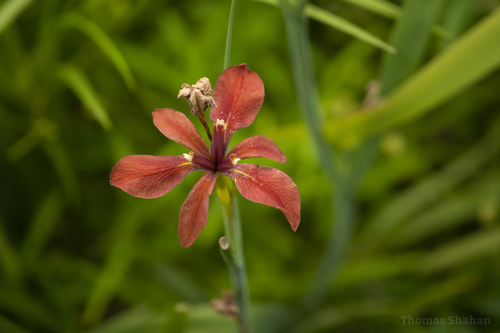
Iris fulva Ker Gawl. has a slender greenish-brown rhizome, which is occasionally red, and bears ring-like scars from old leaves of previous seasons. Rhizomes are approximately 1.5–2 cm in diameter, with shallow fibrous roots beneath them, and can produce many branches that eventually spread out to form large clumps around 1–2 feet wide. The plant produces new leaves early in autumn, which persist through winter into spring, so it is generally only leafless around August. The bright green, blade-like (long and narrow) leaves are lightly ribbed parallel to the stem; they emerge from the plant’s base and arch away from the stem. They measure 60–100 cm (2 ft 0 in – 3 ft 3 in) long and 1–2 cm (½ to 1 inch) wide. Dykes noted that when held up to light, the leaves have black dots, similar to the leaves of water-irises. Some leaves grow along the flower stem, which botanically term this cauline. The flower stem is generally straight with one or two branches, and reaches a height of 45–80 cm (18–31 in). It is mid-green, with 1–3 alternate leaves growing along it that are very similar to basal leaves but smaller. Flowering normally occurs between spring and early summer, from April to June, with one or two flowers per axil of each alternate leaf along the stem. A single stem can hold as many as 4–6 flowers, and occasionally more. In Australia and New Zealand, it blooms between September and November. The total blooming period lasts about 3 weeks, though individual flowers are fairly short-lived, surviving only 1–4 days. The flowers are slightly fragrant, and occur in a range of red shades from copper-red (reddish orange to brownish orange), to brick-red, rust-red, deep red, and bronze. Yellow-flowered forms are occasionally found. Unlike many other irises, the falls and standards of the flower are the same colour. It has a 2–2.5 cm perianth tube. Iris fulva is unusual because all six of its petals droop away from the centre of the flower. The open flower has three drooping falls (sepals), which are 2.5–3.2 cm (1–1.25 in) wide and 5.7–6.4 cm (2.25–2.5 in) long, and three drooping standards (petals), which are 4.5 cm long and 5–7 cm (2.0–2.8 in) across. The base of each flower is tubular with a yellowish centre. It has short styles (female parts) that are about 2 cm long. Inside the flower, the stigma has two small pointed teeth (lobes). The filaments (stalks that hold the anthers) are yellow, the anthers are cream and reach the stigma, and the pollen is cream. Iris fulva shares very similar seed capsules and seeds with Iris brevicaulis. The green seed capsules are six-angled (hexagonal in cross-section), elliptical to oval in shape, measuring 4.5–8 cm (1.8–3.1 in) long by 2.5 cm (0.98 in) wide. Seeds are arranged in two rows inside the capsules. The seeds are flat and irregular in shape, measuring 10-15mm wide. Like other Louisiana irises, they are covered in a cork-like substance that allows them to float on water to new locations within their swamp habitats. It is native to North America, originating from the southern United States including Arkansas, Illinois (specifically in the LaRue swamp on the Big Muddy River), Kentucky, Louisiana (in the Mississippi valley), Mississippi (along the banks of the Mississippi River, and rarer on the eastern side), Missouri, Ohio (Champaign County and Clark County), Georgia, Florida (only rarely found in Santa Rosa County), and Tennessee. It grows in freshwater habitats including marshes, stream banks, field or roadside ditches, drainage canals, swamps, and wet pastures, and is normally found in water up to 15 cm (6 inches) deep. Like Iris brevicaulis, Iris fulva is primarily pollinated by hummingbirds seeking nectar, mainly the ruby-throated hummingbird (Archilochus colubris). It also attracts butterflies. Some parts of the iris are poisonous. Both foliage and rhizomes are deadly toxic, so most mammalian herbivores usually leave the plant untouched. However, the muskrat (Ondatra zibethicus) occasionally feeds on its rhizomes and lower stems, and the white-tailed deer (Odocoileus virginianus) sometimes nibbles the leaf edges. Louisiana irises generally all share similar cultivation requirements. They need full sunlight, a minimum of six hours during summer, and moist, acidic soils with a pH of 6.5, that have high organic content and high fertility. Moisture is essential for best flowering during late autumn, winter, and spring (October to May), when the plant begins to grow new leaves. A light feeding can be given between autumn and spring, if needed. It is estimated to be hardy in USDA Zones 3 to 10. It can tolerate frost, but will flower poorly in areas with cool summers. It can be grown in southern UK in damp or wet soils, and can be grown in most of the United States, New Zealand, and Australia. It can be planted along the edges of ponds and pools, or planted directly in the water, but rhizomes must be pinned into the ground to stop them from floating away. Rhizomes must also be covered in gravel to prevent fish from disturbing the roots. It can also be planted in streams, but not in fast-flowing rivers. It can tolerate pools up to 15 cm (6 inches) deep. It can also be grown in containers, even in water or bog gardens, but must be re-potted and divided every year. If using fertilizer, sprinkle it around the plant in late January or February, before the plant comes into flower. New plantings need to be mulched to prevent sun-scalding. Plantings grown in water do not need mulching and tend to grow more quickly than other plantings.