About Iris florentina L.
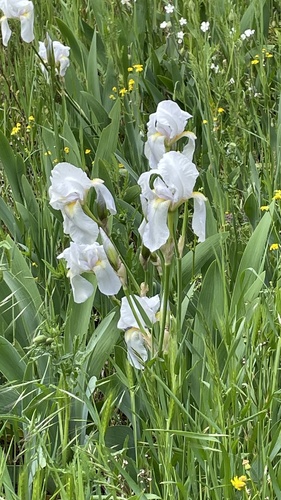
Iris florentina L. has a short, fleshy, thick or stout horizontal rhizome with a strong violet scent. Its rhizomes spread across the soil surface to form plant clumps, and this growth habit often creates a dense network of fibrous roots that can crowd out other plants. It produces basal leaves that grow directly from the rhizome; these leaves are ensiform (sword-shaped), and range in color from light green, pale green, to grey-green. They are semi-evergreen, or evergreen in mild winters, growing 30 to 70 cm (12 to 28 in) long and 2.5 to 4 cm (1 to 2 in) wide, and are shorter than the plant's stem. The straight stem, also called a peduncle, is typically 30 to 100 cm (15 to 39 in) tall, and can reach 75 to 100 cm after around three years, and up to 121 cm (48 in) in ideal conditions. The stems have 2 to 4 branches that decrease in size from the middle of the stem upward, and some branches can be long. The stem holds 1 to 2 membranous or sub-membranous (scarious) spathes, which are specialized leaves that enclose the flower bud. By flowering time, the spathes turn brown and papery, or become fully scarious; the lower spathes are green and leaf-like, and spathes can grow up to 40 to 80 cm (16 to 31 in) long, and are 1.5 to 2 inches long. It has a short pedicel (flower stalk) and a green perianth tube that is 3.2 cm long, normally covered by the spathes. The stem and its branches hold 4 to 8 flowers at their terminal ends, sometimes growing in pairs. The fragrant, violet-scented flowers bloom in spring, early summer, or mid-summer, between late April and May, or between March and May. The large flowers can reach up to 25 cm (10 in) in diameter, and are colored white (sometimes described as 'dead white'), greyish white, bluish white, or very pale lavender, with a slight flush or tint of blue, pale blue, or lavender, especially when in bud. Like other irises, it has two pairs of petals: three large outer sepals called 'falls' and three smaller inner petals (or tepals) called 'standards'. The deflexed or drooping falls are obovate or wedge-shaped (cuneate), measuring 7.6–9 cm (3–4 in) long and 3.8 cm (1 in) wide. There is greenish-yellow veining on the haft, the section of the petal closest to the stem, and the center of the falls has a narrow fillet of white ciliated hairs called a beard, with deep yellow, bright yellow, or orange-yellow tips. The standards are erect, obovate, and narrower than the falls, and the hafts of the standards have a small white beard. It has toothed style branches that are 3.8 cm long, with deltoid crests, and an oblong, pearl-colored stigma. After flowering, between July and August, it produces a fusiform (spindle-shaped), trigonal, or oblong seed capsule. This capsule is longer than the seed capsule of Iris germanica, it is loculicidal (has chambers), with 3 cells that hold brown or dark brown seeds, which are normally arranged like rolls of coins. Iris florentina is native to central and southern Europe, and occurs in Italy (including Tuscany), France, and Mediterranean islands including Malta. It has been cultivated since ancient times, and may be the oldest iris in cultivation. It was collected by Lange in 1860, and has been in cultivation since at least 1400 BC. It also originates from Yemen and Saudi Arabia, and appears in a wall painting of the Botanical Garden of Tuthmosis III in the Temple of Amun at Karnak in ancient Thebes, dated around 1426 BC. Botanist Desfontaines found it in Algiers, where it is grown with Iris germanica near graves. It has been naturalized in many other countries, ranging from the Mediterranean (including west Africa and southern Spain) to India and Iran. In Russia, it grows in the south of western Siberia. Outside Russia, it is found in Kazakhstan, Mongolia, and China. In many regions of the world, especially Italy, it is cultivated for commercial use. In the wild, it grows on sunny mountain slopes, steppes, and sandy or rocky dry slopes. It naturalizes along roadsides, field margins, olive groves, abandoned vineyards, and other cultivated sites. Like many other irises, most parts of the plant (rhizome and leaves) are poisonous. If ingested, it can cause stomach pains and vomiting. Handling the plant may also cause skin irritation or an allergic reaction. In 1948, G.R Winter noted in J Periodont 19:108 that allergic reactions can be caused by using dentifrice (tooth cleaner) that contains orris root powder from this species. It is hardy between USDA Zones 3 and 9, or between Zones 5 and 8. In Europe, it is also hardy to Zone H2, tolerating temperatures between −15 and −20°C (5 to −4°F). Its hardiness has been tested in Russia at the botanical gardens of Barnaul, Novosibirsk, St. Petersburg, and Ufa, where it requires protection from moisture in winter. It can be cultivated successfully throughout Europe and North America, except for the warm, moist climates of Florida and the Gulf Coast. Iris florentina is included in the Tasmania Fire Service's list of low flammability plants, meaning it is suitable for growing within a building protection zone. It prefers to grow in moist, well-drained loam soils, but can tolerate sandy soils and any common garden soil. It tolerates most soil pH levels, including very alkaline or acidic soils. It prefers growing in full sun to light shade, and will develop rhizome viruses in waterlogged soil. It can be grown in mixed flower borders, rock gardens, and along the edges of shrubberies, as well as being naturalized in the garden, and used as a cut flower for displays. It is deer and rabbit resistant, but can be affected by leaf spot, iris borer, thrips, slugs, and snails. The aphids Aphis newtoni and Dysaphis tulipae can also infest the plant. To cultivate, irises are planted shallow, leaving the tops of the rhizomes exposed to the sun. They are not mulched, as mulching can cause rhizome rot. They can be fertilized in early spring and again in late summer with a general fertilizer or bone meal. Foliage can be cut back in autumn after the flowers have faded. The violet-scented rhizome has many uses: it is used in perfume, mixed with hair powder, added to powder for washing clothes, hair, and teeth, used to add a fresh scent to linen, used as a base for dry shampoos and tooth powders, added to face-packs, and used as a fixative in pot-pourri. It was used medicinally as an expectorant to clear mucus from the airways and as a decongestant. It was also formerly used to treat wounds and chest infections, administered to cure dropsy, and sometimes used for bronchitis, coughs, sore throat, colic, and liver congestion. It is rarely used medicinally now. It has been chewed as a breath freshener, carved into rosary beads, and given to babies as a teething aid. It is still used in cosmetics, perfumes, soaps, and sweets. It is also used to mature Chianti wine, and is an ingredient in Bombay Sapphire Gin.