About Iris domestica (L.) Goldblatt & Mabb.
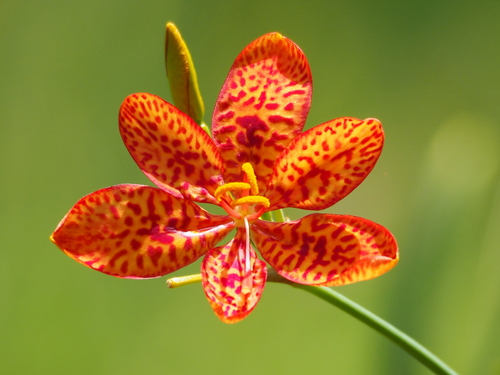
Iris domestica (L.) Goldblatt & Mabb. is a perennial herb that grows between 0.6 and 1 metre (2 ft 0 in – 3 ft 3 in) tall. Its rhizomes sit in shallow ground and spread horizontally. This species produces 3 to 5 stems, each bearing 8 to 14 leaves arranged in a fan. It blooms in summer, with flowers that grow upright near the base of the plant and carry scattered dark orange-red pigment spots. In autumn, its seed pods split open to reveal clusters of shiny black seeds; the seeds' similarity to blackberries gives the plant its common name of "blackberry lily". It is hardy to USDA plant hardiness zone 5, and can be propagated either by seed or by division of existing plants. In the wild, it grows in grasslands, pastures, forest clearings, meadows, mountainous regions, and shrublands. While it has escaped cultivation in many regions, it is not thought to have the potential to become an invasive species. Iris domestica is native to Eastern Asia, and has been cultivated globally in both subtropical and temperate climates. Due to the ornamental appeal of its flowers, it was introduced to Europe as early as the 18th century, and to the United States and Caribbean countries during the 19th century. It is a widely used ornamental plant, grown in private and public gardens, zoos, and floral displays. Its flowers produce nectar and pollen that feed insects and birds. This plant has also been used in traditional medicine.