About Iris cristata Aiton
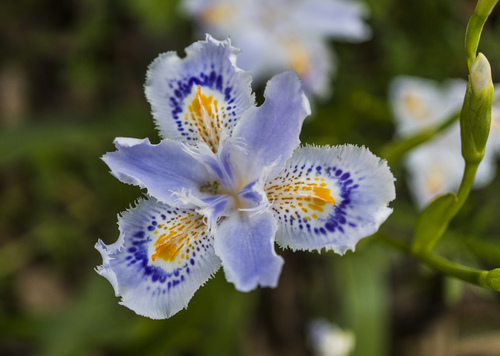
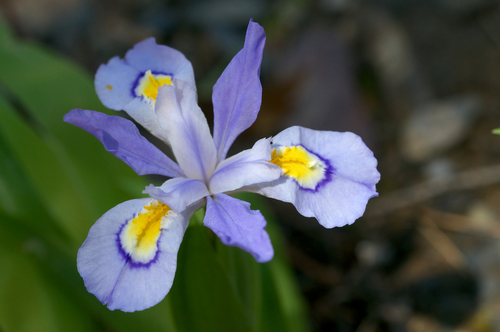
Iris cristata Aiton has slender, greenish to whitish yellow shallow-rooted rhizomes that spread via long stolons from multiple branches. It can produce up to 2–8 cord-like brown branches, which measure 20–30 cm (8–12 in) long and 1–2 mm wide, with fleshy roots growing beneath the rhizomes. Over time, its creeping growth habit forms large dense masses of plants. It produces 6–8 basal leaves, split into 2–3 proximal leaves located close to the plant’s center and 4–5 distal leaves located further from the center. Proximal leaves are sickle-shaped (falcate), light brown with a darker brown central midrib; distal leaves are sword-shaped (ensiform), green to yellowish green with a few visible veins. Leaves normally grow between 7.5 and 15 cm (3 and 6 in) long and 1–2.5 cm wide, and elongate after flowering to reach 15–40 cm (6–16 in) long; these elongated leaves hide any seed pods that develop later. The plant has very short stems, appearing almost stemless, growing only 2.5 to 4.5 cm (1 and 2 in) tall. The flower stalk (pedicel) is the same length as the ovary, and the full height including stem and flower is 7–10 cm (3–4 in) tall. It holds 2–3 stem-born (cauline) spathes, which are the bud leaves of the flower. These spathes are green, sickle-shaped, slightly inflated, and unequal, with outer leaves shorter than inner leaves, measuring 2–6 cm (1–2 in) long. Each spathe produces 1 or 2 flowers that bloom in spring or early summer, between April and May, for only a short period. The fragrant flowers are 3–5 cm (1–2 in) across, and come in shades of blue ranging from lavender to lilac to pale blue, plus purple; white forms occur occasionally, and pink forms are very rare. The flower has two pairs of petal-like structures: 3 large outer sepals called 'falls' and 3 smaller inner petals or tepals called 'standards'. The spreading falls are 3–6 cm (1–2 in) long and 1.5–2.5 cm wide, with a central white signal patch surrounded by a purple or dark blue ring, marked with 3 parallel orange or yellow crests or ridges. The fall tapers toward the claw, the section closest to the stem. Standards are erect, oblanceolate, 3–4 cm (1–2 in) long and 1–2 cm wide, and are narrower and shorter than the falls. It has a thread-like (filiform) perianth tube that is 4–8 cm (2–3 in) long, which lifts the flower above ground level. It also has a triangular ovary 0.6–1 cm long, an oblong stigma half the size of the falls, and a 1.5 cm long triangular crested style branch. After flowering, it produces an ovoid seed capsule 1–2 cm long, with ridged angles and a triangular cross-section. Inside the capsule are ellipsoid yellowish-brown seeds 3.2–3.5 mm across, each with a white appendage that wraps spirally around the seed. Iris cristata Aiton is native to temperate regions of the United States. It is found in the northeastern U.S. in Indiana, Ohio, Pennsylvania, and West Virginia; in north-central U.S. in Illinois, Iowa, Missouri, and Oklahoma; and in southeastern U.S. in Alabama, Arkansas, District of Columbia, and Georgia. It occurs in the Ouachita Mountains, Allegheny Mountains, Appalachian Mountains, and Ozark Mountains, and its range lies south of the maximum extent of the Wisconsinan glaciation from around 11,000 years ago. It grows in calcareous soils in oak woodlands and forests, rocky hillsides, ravines, mountain ledges and bluffs, and along streams. Like many other irises, most parts of the plant (especially the rhizome and leaves) are poisonous. Accidental ingestion can cause stomach pain and vomiting, and handling the plant may lead to skin irritation, allergic reactions, and dermatitis. It is hardy between USDA Zone 3 and Zone 9, and to European Zone H2, meaning it can tolerate temperatures down to −20 °C. It prefers well-drained neutral or slightly acidic soils with a pH of 6.1 to 6.5, and favors medium to highly fertile humus-rich soils, though it can also tolerate loamy soils. It can grow in full sun or shade, but prefers cool, semi-shaded positions. It has average to above average water requirements during the growing season, and goes dormant over winter. It can be grown in mixed flower borders, rock gardens, naturalized as ground cover in woodland gardens, or on peat banks alongside other acid-loving plants such as camellias and azaleas. When planting new specimens, it is normally recommended to add peat or leaf-mould and sharp sand or grit to the soil. Roots are planted in spring, summer, or autumn, with the top of the rhizome positioned about 3–5 cm below the soil surface. After planting, leaf mulch can be added around the plants to help retain moisture. The plant can be damaged by snails and slugs, and deer may nibble it; plants can survive deer nibbling, though flowers are often eaten. Other minor threats include iris borer, verbena bud moth, whiteflies, iris weevil, thrips, aphids, nematodes, bacterial leaf blight, soft rot, crown rot, rhizome rot, leaf spot, rust, viruses, and leaf scorch. When grown in ideal conditions, individual plants can live up to 10 years. Smaller, paler, poorer-growing forms were originally mistaken for Iris lacustris. The species is widely available from reputable nurseries in the US, but is rarely offered for sale in Europe. This species is classified as a medicinal plant, and has been used in Cherokee herbal medicine. A decoction made from pulverized root was made into a salve for ulcers, an infusion (tea) of the root was taken to treat liver issues, and a root decoction was also used to treat yellowish urine. The root was also included as an ingredient in creams applied to skin ulcers. The root has also been used as a spice. In the 19th century, hunters in Virginia used the root as a thirst aid; the root taste is initially sweet, then becomes pungently acrid. Within its native region, it is sold commercially as a pollinator plant that attracts bees.