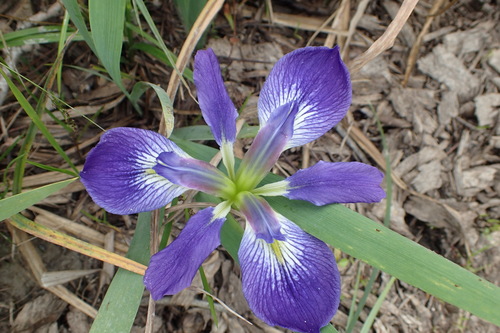
About Iris brevicaulis Raf.
Scientific name: Iris brevicaulis Raf.
Description Iris brevicaulis is the smallest species in the entire Hexagonae series of Louisiana irises. Its leaves and stalks are much shorter than those of other species in the group, and it shares a similar overall form with Iris virginica. Its flowers are normally not visible above the plant’s foliage. This is caused by the plant’s short, zig-zagging flower stems; occasionally, stems also grow along the ground, and the species is often decumbent, meaning its branches grow horizontally before turning upward at the tips.
It has a shallowly rooted, branching rhizome that measures about 10–25 mm in diameter, and colonies of this species can eventually grow to 2 by 3 feet wide. It produces long, glossy, sword-shaped (ensiform) bright green leaves that grow from the plant’s base. These leaves reach 40–70 cm (16–28 in) long and 15–40 mm (0.59–1.57 in) broad.
The plant’s stem is zig-zagged (botanically called fractiflex, which gives the species its common common name of Zig-zag iris), with segments angled at approximately 45 degrees to each other. Stems grow to between 12–20 inches (30–51 centimetres) tall. Each stem holds 3–6 flowers total, with 1–2 flowers at each axil and one to two at the stem terminus. Blooming occurs from early to mid summer: from April to mid-July, or June in the UK. Occasionally, the plant does not produce flowers every year.
Flowers come in a range of blue shades, including violet-blue, lavender, purple-blue, bright blue, blue, and pale blue. A white-flowered form occurs occasionally. The large flowers measure 3.5 to 5 inches (8.9 to 12.7 centimetres) across, with horizontal falls (sepals) that arch downward, and upright standards (petals). The petals are dark-veined and smaller than the sepals, which have a yellow or whitish-yellow signal patch or stripe. A yellow, rudimentary hairy beard (pubescence) grows on the sepals (falls). It has green styles, pale lavender ovate-shaped style crests, and short anthers. It produces a 6-angled seed capsule similar to that of Iris hexagona, which grows 3–5 cm long. Inside are irregular, circular seeds with a cork-like coating that allows them to float, aiding dispersal in the plant’s wet habitat.
Distribution and habitat Iris brevicaulis is the hardiest and most adaptable of all Louisiana irises, and it grows in a wide range of habitats. It is native to North America.
Range: It is found in Ontario, Canada, as far north as the northeast shore of Lake Erie. It also occurs in many southeastern states of the United States: Alabama (along various rivers), Arkansas, Florida, Georgia, Illinois, Indiana, Kansas (Leavenworth), Kentucky, Louisiana, Mississippi (around the Mississippi River basin), Missouri, Ohio, Oklahoma, Tennessee and Texas, including the Big Thicket forest.
Habitat: While most Louisiana irises grow in the bayous of southern Louisiana, Iris brevicaulis can tolerate drier soils than other species and can be found growing away from swamp areas. It grows in moist fields, damp prairies, wet meadows, moist woodlands, streams, riverbanks, marsh areas, around lakes, around ponds, in ravines at the base of wooded slopes in Missouri, and in bottomlands, which are low-lying alluvial areas near rivers. It grows in locations where moisture is generally high during the fall (autumn), winter, and spring growing seasons.
Pollination Iris brevicaulis is primarily pollinated by bumblebees, and is occasionally pollinated by hummingbirds. The pollination process differs between the two groups: hummingbirds must use their head to push back the iris’ petals to reach nectar, and pollen is then transferred on the hummingbird’s forehead.
Toxicity Like many other irises, most parts of Iris brevicaulis (including the rhizome and leaves) are poisonous. Accidental ingestion can cause stomach pains, vomiting, nausea, abdominal pain, diarrhoea, and an elevated temperature. Handling the plant may cause skin irritation or an allergic reaction; the roots, seeds, and plant sap can all cause skin irritation when touched.
Cultivation Louisiana irises generally share similar cultivation requirements. Iris brevicaulis needs acidic soils with a pH of 6.5, with high organic and high fertility content. It prefers full sun but can tolerate partial shade. It prefers wet soils but can also tolerate well-drained soil. For best flowering, moisture is essential from late autumn through winter and spring (October to May), when the plant begins growing new leaves. A light fertilizer application can be given between autumn and spring if needed.
It can be planted along the edges of ponds, streams, and pools, in bog gardens, or along woodland borders. Once established, it produces reliable fresh cut flowers, and it tolerates deer damage. It is generally trouble-free and can even tolerate deer nibbling.
Propagation is most successfully done by dividing rhizomes, which is best done in late summer to early spring when the plants are dormant. Pre-planting ground preparation must include adding a generous amount of organic matter, and soil should be dug to about six inches deep to allow space for new root growth. Clumps need dividing every 3–4 years to encourage good flowering. While it can be grown alongside other plants, it tends to shift to grow into more suitable positions. If using fertilizer, sprinkle it around the plant in late January or February, before the plant comes into flower. New plantings need mulching to prevent sun-scalding.
Growing Iris brevicaulis from seed is not difficult, but it is a very slow process. Germination can take between 3–12 months, with an average germination rate of 50%. Germination works best when done in a cold frame. Seed-grown plants take 3–5 years to reach the flowering stage. Seeds should be harvested directly from the plant after flowering, and must be taken from mature seed pods. Harvested seeds should be stored in paper bags, as seeds stored in glass containers often develop mould.
This species is estimated to be hardy to USDA Zones 4 to 9, and it is considered the hardiest of all Louisiana irises. It can tolerate frost, but will flower poorly in regions with cool summers. It can be grown in southern UK in damp or wet soils, and can also be grown in most of the United States, Canada, New Zealand and Australia. It is often available at water garden centres in the US.