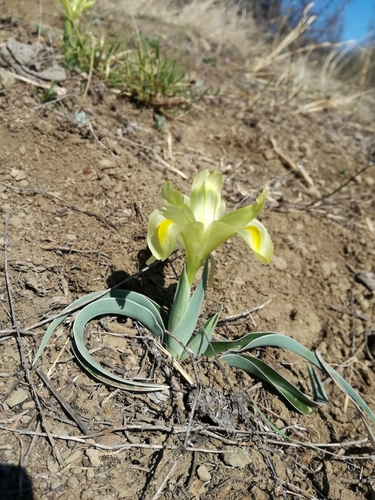
About Iris bloudowii Ledeb.
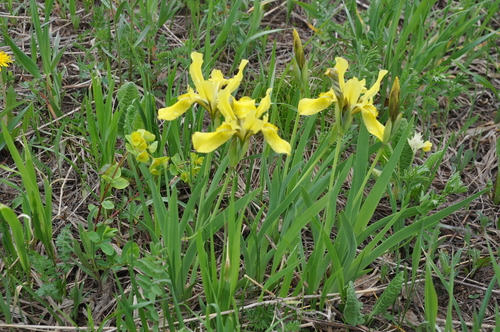
Iris bloudowii Ledeb. is morphologically similar to Iris humilis, another Psammiris species. It has a thick, short, irregularly shaped fibrous rhizome 0.5–1.5 cm in diameter, with numerous yellow-white secondary roots growing beneath it. Brown fibrous remains of old leaves sit on top of the rhizome, which branches many times to form a slowly creeping plant. This species produces 2–4 basal leaves that are linear, lanceolate, or sword-shaped, and slightly curved or sickle-shaped. In spring, the leaves emerge as broad brown shoots before turning light green or greyish green. At blooming time, leaves are 8 to 12 cm long and 4 to 8 mm wide; after blooming, they grow to 15 to 25 cm long and 8 to 13 mm wide. The leaves have 5–6 longitudinal veins but no central mid-vein, and are deciduous, dying back after flowering. It has a slender, unbranched erect stem that reaches 8–10 cm long at blooming, then extends to 35 cm long after flowering, holding flowers above the foliage. The stem bears 2 or 3 keeled, oblong-lanceolate, reddish purple, membranous spathes (bracts) that are 4 cm long and 1.6–2 cm wide. Each stem carries 2 terminal flowers that bloom in late spring, between April and May, or June in Russia. The flowers sit on pedicels 0.5–2 cm long, are 5–6 cm in diameter, and come in a range of yellow shades from bright yellow and clear yellow to dark yellow. The flower has two pairs of petals: three large outer sepals called falls, and three smaller inner petals or tepals called standards. The falls are obovate or ovate, with purple or brown veins extending toward the haft (the section closest to the stem), and have a central yellow or golden beard; they measure 4 cm long and 2 cm wide. The upright standards are oblanceolate, 3–4.5 cm long and 1–1.2 cm wide, and are narrower and shorter than the falls. It has a perianth tube 1–1.5 cm long, which matches the length of the green spindle-shaped ovary that also has 6 purple stripes. The plant also has stamens 1.8–2.2 cm long, and flat bright yellow style branches 2.5 cm long. After flowering between June and August, it produces an oval or ovoid seed capsule on a 1–1.2 cm long stalk, containing dark brown, ellipsoid or oval seeds that are 5 mm long and 3 mm wide. The seeds are wrinkled and have a white appendage called an aril. Iris bloudowii is native to temperate regions of central Asia. Its range includes the Siberian region of the Russian Federation, specifically the regions of Aga Buryat, Buryatia, Chita, Gorno-Altay, Irkutsk, Krasnoyarsk, Tuva, and Primorye. It is also found in Kazakhstan, Mongolia, and the Chinese province of Xinjiang (also called Chinese Turkestan), including the Altai Mountains and Tien Shan Mountains. It occurs in the Altai-Sayan region where Russia, China, Mongolia, and Kazakhstan meet, alongside Iris glaucescens, Iris humilis, Iris ruthenica, Iris sibirica, Iris tenuifolia, and Iris tigridia. Its habitat includes grassy meadow slopes of mountains, the edges of woods and forests, sandy dunes, and coastal meadows. Like Iris humilis, it prefers sandy soils. Like many other irises, most parts of the plant (the rhizome and leaves) are poisonous. Accidental ingestion can cause stomach pains and vomiting, and handling the plant may trigger skin irritation or an allergic reaction. It is hardy to USDA Zones 4 through 9, is very cold hardy, and prefers dry winter conditions. It grows best in well-drained, light sandy soils, and can also grow in gravelly soils. It tolerates mildly acidic to mildly alkaline soils, with pH levels between 6.1 and 7.8, and can grow in full sun positions. It has average water needs during the growing season, and requires dry conditions during winter. In the UK, it grows best in a covered frame, and is rare in cultivation there; it can be grown in open ground in Russia. It is cultivated in rock gardens, and has been grown in Russia since 1829, where it has been tested in the botanical gardens of Moscow, St. Petersburg, Novosibirsk, Chita, and Barnaul. The aphid species Aphis newtoni Theobald can be found growing on Iris bloudowii, alongside Iris latifolia, Iris spuria, and Tigridia pavonia.