About Iris bismarckiana E.Dammann & Sprenger
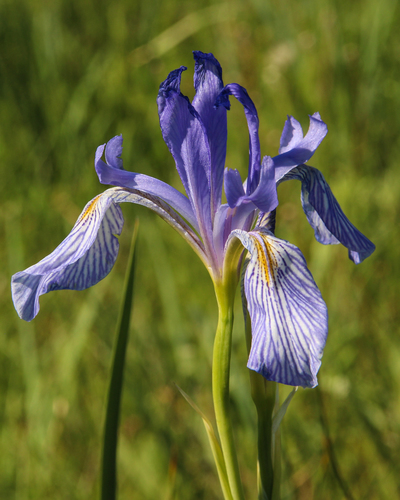
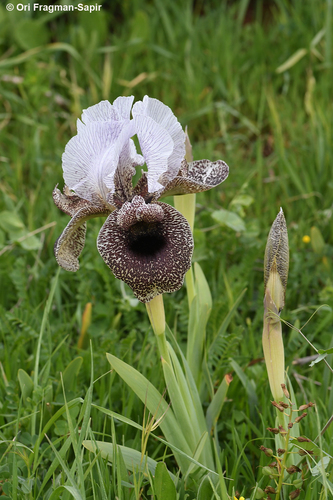
Iris bismarckiana is similar in growth form to Iris susiana and Iris lortetii, which are also Oncocyclus irises, differing from them only in flower color. It is a geophyte with short, narrow stoloniferous rhizomes that are about 1.5 cm in diameter. It produces long, thin stolons that can grow up to several meters underground to seek out minerals, and both the rhizomes and stolons are very susceptible to viral diseases. Its creeping growth habit creates small clumps of plants. This species has 6 to 8 sword-shaped (ensiform), glaucous, bright green leaves that grow 30 to 50 cm (12 to 20 in) long and 2 to 2.5 cm wide. They form erect fans of leaves that are similar in shape to the leaves of I. susiana. It produces a long, slender stem (peduncle) that grows 30 to 50 cm (12 to 20 in) tall, with some stems reaching as tall as 80 cm (31 in). The stem is usually taller than the leaves, and it bears a green, lanceolate spathe (the leaf that encloses the flower bud) that is 7.6 cm (3 in) long. Each stem holds a single terminal flower at the top of the stem, which blooms in spring between March and April; in the UK, it blooms in May. The flowers are 10 to 15 cm (4 to 6 in) in diameter, with a base color that can be pale yellow, yellow-green, cream, creamy-white, or white, and are covered in reddish-brown, maroon brown, purple-brown, purple, blue-purple, light violet, lilac, or blue veins or spots. Like other irises, it has two pairs of petals: three large outer petals (sepals) known as falls, and three smaller inner petals (or tepals) known as standards. It has ovate-shaped falls that are 6 to 7 cm (2 to 3 in) long and 4 cm wide, which are densely spotted or veined and bear a purple-brown or dark purple signal patch at the entrance to the perianth, matching the color of the spotting or veining. In the center of the falls, a row of short hairs called a beard is dark purple or blackish. The standards are much paler in color than the falls, are circular (orbicular) and 7 to 9 cm (3 to 4 in) long, and have paler blue purple, purple, or blue veining or spotting. The flowers are very similar in shape to those of I. susiana. It has oblong-shaped stigmas that match the color of the petals and are also densely veined. This species is pollinated by a small number of specialist pollinator species. After flowering, it produces a seed capsule that splits into three sections to hold multiple seeds. It is native to south Lebanon and northern Israel, and its range also includes Syria and Jordan. Within its range, it is found in Israel in Upper Galilee, Lower Galilee, Mount Hermon, Mt. Yona, and Mount Tabor; in Lebanon on Mount Lebanon and in Wadi Rajib near Adjloon; and in Jordan on the Gilead Mountains. It grows on rocky and stony mountainsides, at the edges of woodlands, and in scrub land. It can be found growing on heavy limestone clays, basalt rocks, terra rossa, and soft chalky rocks, at altitudes up to 1,300 m (4,300 ft) above sea level. Like many other irises, most parts of this plant (including the rhizome and leaves) are poisonous. Accidental ingestion can cause stomach pain and vomiting, and handling the plant may trigger skin irritation or an allergic reaction. It is hardy to European Zone H4, which corresponds to hardiness between −5 and −10 °C (23 to 14 °F). It was first cultivated in Naples in 1888, but its growth was soon damaged by unsuitable local environmental conditions. It is considered fairly difficult to cultivate because it requires high temperatures and dry conditions. William Rickatson Dykes recommended that this iris is best planted in October. It is most commonly used as a garden ornamental plant, and it has also been planted in cemeteries, including in Rajib. Its rhizome has been used in the perfume 'Iris Nazarena', created by New York-based fragrance boutique Aedes de Venustas.