About Iris bicapitata Colas.
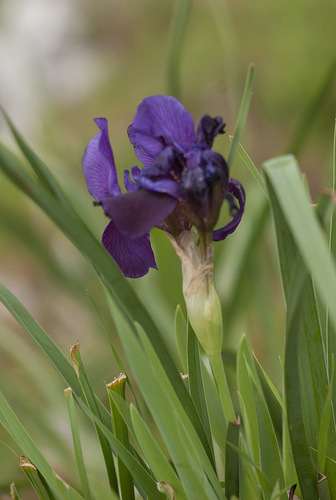
Iris bicapitata Colas. is similar in overall form to Iris germanica, but is slightly smaller. It has a thick, horizontal, fleshy rhizome that matches the form found in other bearded irises. Its leaves are linear, and can be falcate (sickle-shaped) or acuminate (pointed). Leaves grow 30–50 cm (12–20 in) long, which is shorter than the flowering stem, and reach around 2.5 cm wide. The leaf tips are membranous. The slender flowering stem, or peduncle, grows 30–40 cm (12–16 in) tall, and can reach up to 60 cm (24 in) when grown in cultivation. The stem bears carinated (ridged or keeled) spathes (bud leaves), which have scarious (membranous or papery) tips and violet-tinged edges. Stems typically hold 2 terminal flowers (at the top of the stem), though they rarely produce 3 flowers. This differs from other native irises such as Iris lutescens and Iris pseudopumila, which only produce one flower per stem. The fragrant flowers, with a scent similar to roses and violets, bloom between March and May. The species is polymorphic, with flowers that vary widely in colour, ranging from white, yellow, blue, and lilac to violet; flowers can also be bi-coloured. Rarely, individuals produce pale yellow flowers with violet veins, similar to (but less pronounced than) the flowers of Iris variegata. The most common flower colour is deep blue-violet or purple-blue. The flowers are larger than those of Iris pseudopumila and Iris revoluta. Like other irises, it has two pairs of petals: three large outer sepals called 'falls', and three smaller inner petals (or tepals) called 'standards'. The drooping, sub-ellipsoidal falls are 6–8.5 cm (2–3 in) long and 2–3.5 cm wide, with a central beard that is blue or white, with yellow tips. The shorter, obliquely upright standards have tips that lean toward each other. It has a 4 cm long perianth tube, an ovary that is 1.5 cm long and 1.8 cm wide, blue stamens, a stigma that is 4.5 cm long and 1.5 cm wide, and filaments that are longer than the anthers. After flowering, it produces an ovoid or obovate seed capsule that is triangular in cross-section, measuring 7.5 cm (3 in) long and 3.5 cm wide. Iris bicapitata is native to south-eastern Europe. It is found in Italy, specifically in Apulia, including the Gargano Peninsula, and near the town of Monte St Angelo. It grows on open sunny slopes, in meadows, and between sparsely spaced shrubs, on limestone or other calcareous substrates, at altitudes between 600 and 1,000 m (2,000 to 3,300 ft) above sea level. It is normally pollinated by bees (especially bumblebees) and other pollinators. Like many other irises, most parts of the plant (the rhizome and leaves) are poisonous. Accidental ingestion can cause stomach pains and vomiting, and handling the plant may trigger skin irritation or an allergic reaction. It is hardy to USDA Zone 9, and is thought to likely tolerate temperatures below −15 °C, though winters in its native Italian habitat normally do not get colder than −10 °C. It tolerates mild wet winters and hot dry summers. It prefers to grow in well-drained limestone or calcareous soils, and grows best in full sun positions. It can be cultivated in rock gardens. When grown in cultivation, this species is thought to re-bloom in autumn. It is not widely available from plant nurseries, and is only grown by plant collectors.