About Iris atropurpurea Baker
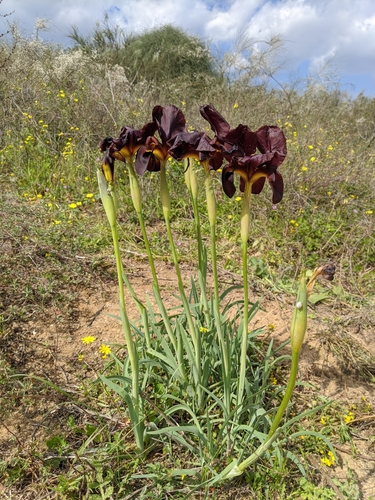
Iris atropurpurea Baker is a geophytic plant with stout, stoloniferous rhizomes that produce long, thin stolons or deep secondary roots. The rhizomes sit flush with the soil surface to absorb sunlight, and can form wide clumps of plants. It produces glaucous, linear, falcate, grass-like leaves that reach 6–11 cm (2–4 in) long and 0.5–0.8 cm wide. These leaves are similar in shape to the leaves of Iris iberica, another iris in the Oncocyclus section. It has a slender stem (peduncle) that grows 15–25 cm (6–10 in) tall. The stem bears green, lanceolate flower bud leaves called spathes, which reach 7.6 cm long. Each stem holds 1 to 2 terminal flowers that bloom in early spring, between February and March in its native range. In the UK, it blooms in May; when cultivated, it blooms later between April and May. Compared to Iris atrofusca and Iris hermona, its flowers have an average longevity of 4.8 ± 1.3 days. The flowers are 8 cm (3 in) in diameter, and come in shades of orange, red-brown, dark burgundy, purple, dark purple, or blackish purple. Flower buds are usually black. Like other irises, it has two pairs of petals: three large outer sepals called falls, and three smaller inner petals (or tepals) called standards. The narrow falls are oblong, measuring 3.6–6 cm (1–2 in) long and 2.5–4 cm wide. Falls are usually a darker shade than the standards, and do not show visible veining due to their dark petal color. They have a blackish or darker signal patch, and a central row of short hairs called a beard that is yellow with purple tips. The rounded standards are incurved, paler than the falls, and measure 5–5.8 cm (2–2 in) long and 4.5–6 cm wide. Standards also have no visible veining, due to their petal color. It has 3.5 cm long style branches with ovate crests, and a green perianth tube that is longer than the ovary. The flowers do not produce nectar as a reward for pollinating insects. After flowering, it produces a seed capsule that has not been formally described. It is native to the coastal plain of Israel, including the Sharon Plain and Philistean Plain. It has been recorded in the Ilanot Kadima Nature Reserve (a botanical forest garden in the Sharon region), and near the Rishon LeZion Shafdan dunes. It grows in poor quality sandy soils, or soils mixed with gravel, such as those found in old sand dunes (or Kurkar Hills) along coastal plains. Along with Iris hermona (another Oncocyclus section iris), it occurs in lime-less soils, which can be light or basalt. Like many other irises, most parts of this plant (specifically the rhizome and leaves) are poisonous. If mistakenly ingested, it can cause stomach pains and vomiting. Handling the plant may also lead to skin irritation or an allergic reaction. It is hardy in dry Mediterranean-like climates. In the UK and some parts of the US, it is recommended to grow this species in pots inside a frost-free greenhouse with forced ventilation. It prefers very fertile seed compost and dislikes sudden temperature changes. According to Dykes, it is best planted in October in the UK. It has also been cultivated in Syria.