About Iris atrofusca Baker
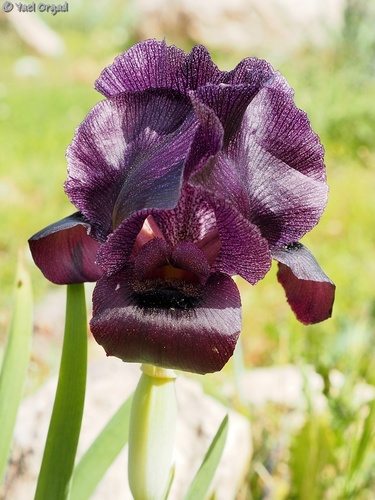
Iris atrofusca Baker has a stout, compact rhizome with very long secondary roots. The rhizomes grow level with the soil surface to gain heat from the sun, and the roots form dense, thick clumps that reach 0.5 m wide. The leaves can be falcate (sickle-shaped), erect, or ensiform (sword-shaped). It is thought that specimens from the Arad valley have falcate (curved) leaves, while those found in the Beersheva (Be'er Sheva) hills have erect leaves. These leaves are similar to those of Iris susiana, another Oncocyclus section iris. The plant can have 5 to 8 greyish-green or pale green, slightly glaucescent leaves, which grow 15–40 cm (6–16 in) long and 0.8–2 cm wide. It has a stout stem (peduncle) that grows 20–45 cm (8–18 in) tall, matching the height of I. susiana. The stem holds pale green, ventricose (swollen or inflated) bud leaves (spathes) that are 9–10 cm (3.5–3.9 in) long. A single terminal flower (borne at the top of the stem) blooms in late March or April. The fragrant flowers are 10–15 cm (4–6 in) in diameter, and occur in dark shades including purple brown, reddish-black, black brown, dark brown, dark lilac, and dark purple; a yellow-flowered form also exists. It is considered the darkest-coloured iris in Israel, and is often called 'black iris' in Jordan. Like other irises, it has two pairs of petals: three large outer sepals called 'falls', and three smaller inner petals (tepals) called 'standards'. The wide falls are recurved, measuring 6–7.5 cm (2–3 in) long and 3–4.5 cm (1–2 in) wide. They have a broad, brownish-black or black signal patch in the middle. Extending from the claw (the narrow section of the petal near the stem) along the middle of the falls is a row of short velvet-like hairs called the 'beard', which is brown-black, light brown, or yellow with brown tips. The paler standards are incurved, growing up to 7–9 cm (3–4 in) long and 3–4.5 cm (1–2 in) wide. They have heavy black veining and many reddish-black dots. The flowers are smaller than those of Iris haynei, another Oncocyclus section iris. Compared to Iris atropurpurea and Iris hermona, other Oncocyclus Section irises native to Israel, Iris atrofusca has the longest floral longevity at 6.7 ± 1.3 days. It has 5 cm (2 in) long style arms that are greenish yellow and spotted with purple, white anthers, an oblong-shaped ovary, short filaments, and a 5 cm (2 in) long cylindrical green perianth tube. After flowering, it produces a three-parted seed capsule that holds many seeds inside. A 2005 study found that pollen is transferred between flowers by night-sheltering solitary male bees, which are the only known pollinators of this species. This species is native to temperate Western Asia, found in Israel, Jordan, and the Palestinian Territories (near Nablus). Its range extends across the deserts of Samaria, the Judean Desert, Negev Desert, Beit Shan Valley, southern Golan Heights, Jordan Valley, and the valley of the Dead Sea. It grows in arid deserts, dry hills, rocky/stony slopes, loessial plains, semi-steppe shrublands, and even agricultural fields. Plants in the Arad valley have been under cultivation for several thousands of years. It can be found at altitudes between −250 to 300 m (−820 to 980 ft) above sea level. Like many other irises, most parts of the plant (especially the rhizome and leaves) are poisonous. If mistakenly ingested, it can cause stomach pains and vomiting. Handling the plant may also cause skin irritation or an allergic reaction. It is hardy in regions with a dry summer and full sun, and prefers to grow in well-drained soils. Oncocyclus Section Irises are easier to grow than Regelia Section Irises, but should preferably be grown under glass in frames to protect them from excess moisture, especially during winter, and to ensure shallow-planted rhizomes get the best temperatures during the growing season. They can be grown in pots, particularly deep pots called 'long toms', but they need re-potting every 2 years and extra feeding. Watering is one of the most critical aspects of iris cultivation. Growth starts in October, and watering should begin carefully; water should never be poured directly onto the rhizomes.