About Iris arenaria Waldst. & Kit.
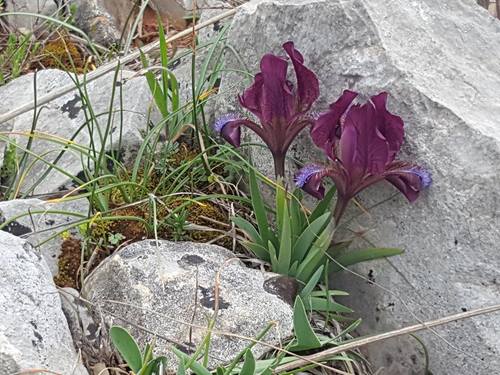
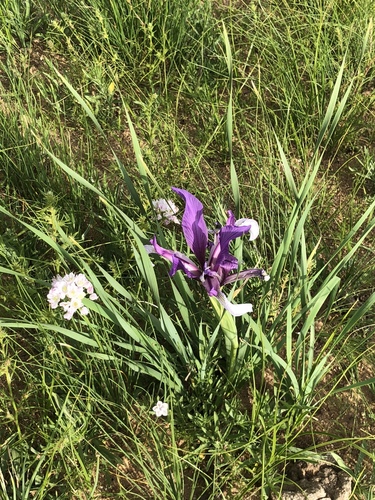
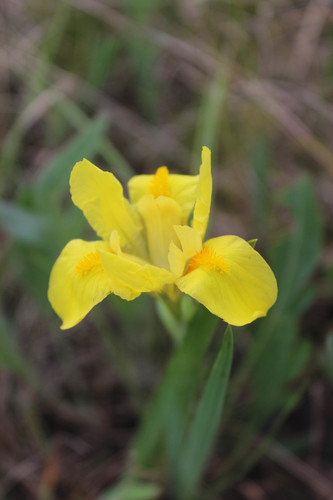
Iris arenaria Waldst. & Kit. is overall similar in form to Iris pumila, but is smaller in all parts. It has a long, thin rhizome that is roughly 2–5 mm thick, with many thickened branched nodes. These creeping, branched rhizomes form clumps of plants, and the rhizome retains the remains of the previous season’s leaves. It produces long, thin, flat leaves that measure 5–32 cm (2–13 in) long and 1.5–10 mm wide. It has an erect, simple, unbranched green stem that reaches 5–25 cm (2–10 in) in height. The stems carry 1–2 green, lanceolate, membranous (scarious) spathes, which are modified leaves surrounding the flower bud, that measure 2–3.5 cm wide. It has short flower stalks (pedicels) that are just 6 mm long. Stems hold between 1 and 2 flowers in spring, between April and May. Flowers have an extremely short blooming period that lasts only one day: they open in the morning and close by the afternoon. The fragrant flowers carry a vanilla scent, and come in a range of yellow shades, from pale and light yellow to bright yellow. The flower has two pairs of petals: three large outer sepals called 'falls', and three smaller inner petals (or tepals) called 'standards'. The falls are sub-orbicular, 30–35 mm (1–1 in) long and 1.3 cm wide, with purple veins and an orange or deep yellow beard. The standards are narrow, oblanceolate, with a short claw (the section closest to the stem), and are 27–33 mm (1–1 in) long, with darker veins. It has a hypanthial (cup-shaped) or infundibuliform (funnel-shaped) perianth tube 5–12 mm long, and a three-angled oblong ovary. After flowering, it produces an oblong or fusiform (spindle-shaped) seed capsule between July and September. The capsules split open (dehisce) laterally, similar to Iris korolkowii. Inside the capsules are brown, ovoid, globose or pyriform seeds that each have a circular aril. Iris arenaria is native to central and eastern Europe. It can be found in Hungary (including Kiskunság), Austria, Romania, Czech Republic, Slovakia, and Ukraine, and is common across the Pannonian steppe, which spans parts of Austria, Bulgaria, Hungary, Romania, Serbia and Slovakia. It grows on sunny rock steppes and stony slopes, ranging from lowlands to highlands. In Ukraine, it occurs in pine forest steppes beside the Seversky Donets river, on sandy riversides, and in sand dunes. In the Czech Republic, it grows in the sand dunes of Čenkov, located within a national nature reserve. It also grows in the dunes of Romania. It prefers shallow, sandy soils. It is a hardy plant, hardier than Iris humilis, though it may require winter shelter. It grows best in sandy, well-drained soils with lime, and prefers positions in full sun. It can be cultivated as a rock garden or alpine plant, and is rarely grown in the UK.