About Iris aphylla L.
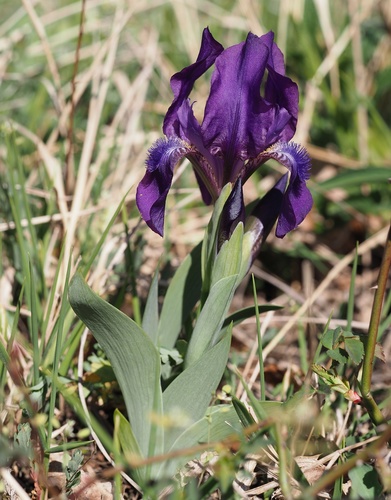
Iris aphylla L. is a naturally variable species, with wild variation most noticeable in flower colour, stem height, leaf size, and perianth tube length. It has a stout, thick rhizome with several stem buds that creeps along the ground to form dense clumps. Its leaves grow directly from the rhizome; they start dark or intense green, later fading to grey-green, and are often flushed purple at the base. The leaves are sword-shaped (ensiform), glaucescent, and sickle-shaped (falcate), growing 15–45 cm long and 2–3 cm wide. Outer leaves are normally shorter than inner leaves, and leaves are sometimes longer than the flower stems. This species is deciduous: its leaves die back in winter, leaving the plant leafless with a 'naked' stem, which gives it the common name 'leafless iris'. New leaves re-grow in March the following year. It produces a slender stem that grows 6.5–30 cm tall, and very occasionally reaches 50–70 cm tall. Stems are sometimes the same height as the leaves, and are sometimes shorter than stems of Iris germanica, with longer leaves than stems. The stem has 1–2 branches (pedicels), rarely 3, growing from the base up to the middle of the stem. Occasionally, a rhizome produces two flower stems, or a branch forms at ground level, making two stems appear to rise from the rhizome. The stem bears 1–2 spathes (flower bud leaves), which are green, purple-stained, or purple at the apex; they remain greenish at flowering time, and can be narrow and rounded, ovate, oblong, or oblong-lanceolate, measuring 3–6.5 cm long. They sometimes have a scarious (membranous) tip. Stems and their branches hold 3–5 flowers that bloom from spring to early summer, between April and May, May, or May and June. Occasionally, it produces a less vigorous secondary autumn bloom between August and September or September and October, only when growing conditions are good. Flowers are only open for a few days. These large, fragrant flowers have a diameter of 4–7 cm, and appear stacked above one another. Flower colour ranges from bright purple, purple, violet, dark blue, blue-violet, and dark violet to dark purple; bright reddish-purple forms are found in Moldova. It has a short 0.5 cm long pedicel, and a cylindrical green perianth tube that is purple-stained and 1.6–2.5 cm long. Like other irises, it has two pairs of petals: three large outer sepals called falls, and three smaller inner petals (tepals) called standards. The falls are wide, obovate, often retuse (rounded), 4–6.5 cm long and 2–3 cm wide, narrowing to a pale wedge-shaped (cuneate) haft (the petal section closest to the stem). The falls or their hafts are striped with white. In the centre of the fall is a whitish, blue-tinged white, or pale blue beard, tipped yellow or orange at the back. The standards are oval with an elliptical limb, 4–6.5 cm long and 2.2–3 cm wide, narrowing to a grooved (canaliculate), brown-marked haft or short claw. Standards are slightly broader than the falls. It has pale style branches 0.6–1 cm long with deltoid crests, 1.5 cm long very pale violet filaments, oblong 1 cm long ovaries, blue-edged anthers, and white or bluish pollen. After flowering, it produces a seed capsule in August: the capsule is cylindrical, blunt and triangular, or oblong and hexagonal, 3–6.5 cm long and 1.3–2.3 cm wide, with 6 grooves. Inside the capsule are obovate, ovoid, globose, or pear-shaped (pyriform) brown or dark reddish brown wrinkled (rugose) seeds, 4.5–5.2 mm long and 2.9–3.3 mm wide. It is native to parts of Central and Eastern Europe and temperate Asia. In temperate Asia, it occurs in the Caucasus, including Azerbaijan, and the Russian Federation regions of Ciscaucasia and Dagestan, as well as Armenia and Georgia. In Europe, it is found in Czechoslovakia (only central Bohemia and central Czechia), Germany, Hungary, Poland, Belarus, Ukraine, Bulgaria, Albania, Former Yugoslavia, Italy, Romania (the Transylvanian Basin and Szeklerland), France, and Turkey. Some sources record it in Great Britain and Ireland, but this likely refers to naturalized plants. It grows from lowlands to sub-alpine uplands across the Alps, in a range of habitats including grasslands, meadows, hillsides beside limestone and sandstone rocks, forest glades, scrub or thickets, and alongside roadsides and paths. In the Czech Republic, Germany, and Poland, it grows on sandstone in Luzulo-Fagetum beech forests and Vaccinio-Quercetum pine-oak forests. In Hungary, it grows in acacia forests. Like many other irises, most parts of the plant (rhizome and leaves) are poisonous. Accidental ingestion can cause stomach pains and vomiting, and handling the plant may lead to skin irritation or an allergic reaction. It is naturally cold-resistant and hardy between USDA Zones 3 to 8, including Zone 5. Its hardiness has been tested in botanical gardens in Moscow, Stavropol, Chita, and St Petersburg, Russia. It does not grow well in southern climates, as it dislikes long hot, humid spells. It prefers well-drained soil, but can tolerate loamy and heavy soils. It tolerates soil pH from 6.1–6.5 (mildly acidic) to 7.6–7.8 (mildly alkaline), and can tolerate dry soil, though it prefers average moisture. It grows best in full sun, and can be planted in mixed garden borders or rock gardens. It is best planted between August and September to produce flowers the following year. It is susceptible to viruses and slugs; Mononychus punctumalbum (iris weevil) attacks its seeds, and the aphid Dysaphis tulipae can also infest the plant. It is only available from specialised nurseries, and cultivated specimens are held in botanical gardens including The Bolestraszyce Arboretum near Przemyśl, Poland.