About Iris adriatica Trinajstic ex Mitic
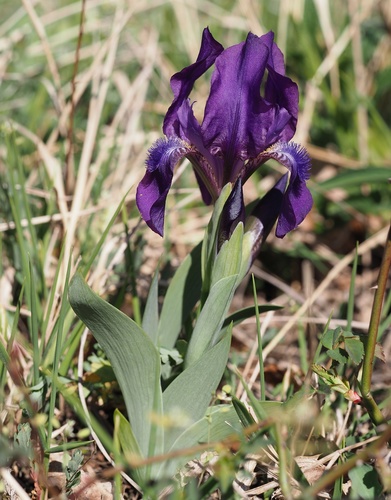
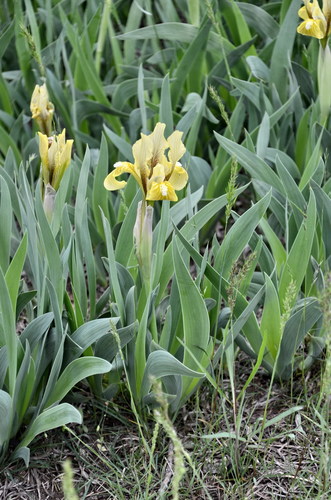
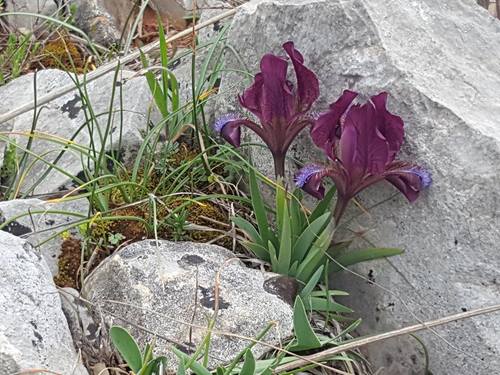
Iris adriatica Trinajstic ex Mitic is similar in form to Iris pseudopumila, Iris pumila and Iris attica. It has a rhizome, and produces falcate (sickle-shaped) or straight leaves that grow 3–10 cm (1–4 in) long and 0.5–1 cm wide. Its leaves are normally longer than the flowering stem and die back in winter. It has a dwarf stem that reaches 1–5 cm (0–2 in) tall. The stem carries green spathes (flower bud leaves) with wide membranous (scarious) margins; these spathes measure 4–7 cm (2–3 in) long, a size similar to the perianth tube, and are slightly keeled when the plant blooms. Each stem holds one terminal flower at the top of the stem, which blooms in spring, during March and April. The large flowers come in shades of yellow, red, purple, or violet, or a combination of these colours. Like other irises, it has two pairs of petals: three large outer sepals called 'falls' and three smaller inner petals or tepals called 'standards'. The centre of the falls has a beard that is either blue or yellow. After flowering, the plant produces a ripe seed capsule that is elliptical or trigonous (three-angled), 2–3 cm long, and straw-coloured. Inside the capsule are numerous small, elliptical, dark brownish seeds, which are smaller and darker than the seeds of other similar irises. Iris adriatica is native to Europe. It is found in the Dalmatia region of Croatia, a Mediterranean country, including around the Croatian towns of Zadar, Šibenik, Split, Drniš and Unešić, as well as on the islands of Ciovo, Brač, Kornati, and Vir. It grows in sandy meadows containing 'Stipo-Salvietum officinalis', a plant community mixing Stipa grasses and Salvia officinalis sage, and 'Festuco-Koelerietum splendentis', a community mixing Festuca and Koeleria splendens grasses. It can also grow in rocky pastures, and occurs at altitudes of 0–100 m (0–328 ft) above sea level. Like many other irises, most parts of Iris adriatica (particularly the rhizome and leaves) are poisonous. Accidental ingestion can cause stomach pains and vomiting, and handling the plant may lead to skin irritation or an allergic reaction. It is hardy to USDA Zone 8, requires dry summers, and is generally considered difficult to grow in cultivation. It can be found growing in Biokovo Botanical Garden Kotišina.