About Iridomyrmex purpureus (Smith, 1858)
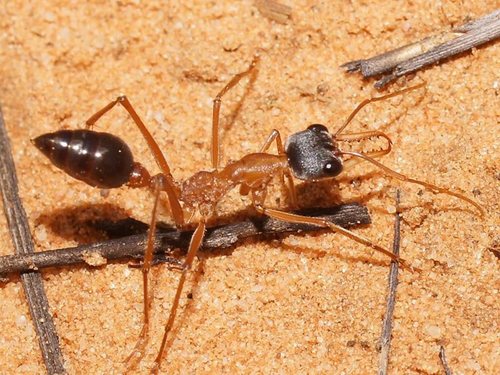
Iridomyrmex purpureus, commonly known as meat ants, have the following morphological description. In general, meat ants are medium to large, measuring 6–12 mm (0.24–0.47 in), and are easily recognised by their dark-bluish body and red head. Most often, their heads and pronotums are similar in colour and lighter than the mesothorax (the middle of the three thoracic segments) and propodeum (the first abdominal segment), which are reddish brown. However, the head may sometimes be lighter, and the pronotum and mesothorax may share the same colour. Mesosomal setae (hairs on the mesosoma) are dark and sometimes translucent. Iridescence between the compound eyes and the lateral portion of the head ranges from slightly purple to strong dark purple. Legs and coxae (the basal leg segment that attaches to the body) are darker than the mesothorax, and the petiole (narrow waist) is reddish brown and also darker than the mesothorax. The lateral portion of the second gastral tergite (a dorsal segment behind the head) is shiny, and iridescence varies among workers, ranging from green or blue to a mix of plain green and purple. Soft head hairs are common around the occipital margin, and three to eight pale setae are usually seen around the mandibular insertion. Soft hairs are also common around the first gastral tergite. No examined specimens have been found to have ocelli. Erect setae on the pronotum are abundant. The anterodorsal (front and toward the back) portion of the propodeum is arched and flat. There are no allometric differences among workers. On average, workers measure around 6–7 mm (0.24–0.28 in); this size difference distinguishes workers from queens, along with differing body colour patterns. For workers, the head and pronotum range from orange to brick-red, and the mesonotum and propodeum are either lighter, the same colour, or darker than the head. The gaster can be brown or black with blue or purple iridescence, and legs are either orange or brown. Iridescence around the foreparts appears in blue, pink, pale greenish yellow, and purple. Erect setae are brown. The head has a concave posterior margin, with abundant erect setae in front of the face. The sides of the head are convex. Fully erect setae on the genal (side head region) may be present or absent, though a small number of setae may be seen around the mandibular insertion. Eyes are semicircular and positioned near the midpoint of the head capsule. Frontal carinae (keel-shaped ridges) are convex, and antennal scapes extend beyond the head's posterior margin by two to three times their diameter. Erect setae cover the entire antennal scape, and are noticeably prominent on the clypeal margin (a shield-like plate at the front of an insect). Mandibles are elongated and triangular, with long curved setae around the head capsule. The pronotum is evenly curved, with at least 12 or more pronotal setae. These setae are mostly short and bristly. The mesonotum is sinuous (has many curves), and like the pronotum, has 12 or more mesonotal setae. Mesothoracic spiracles are very small, and the propodeal dorsum is smooth or convex. A number of propodeal setae are also present. The dorsum of the node (a segment between the mesosoma and gaster) is thin, scale-like, and sometimes vertical. Both non-marginal and marginal setae are present on the first gastral tergite around the gaster. Queens are easily distinguished from workers by their black colour and larger size, measuring 12.7 mm (0.50 in). Queens are mostly dark black. Antennae and legs are ferruginous (rust-like colour), the head is fusco-ferruginous, and the sides beneath the face and mandibles are ferruginous. The head is wider than the thorax and emarginate. An impressed line runs from the anterior stemma to the base of the clypeus. The thorax is ovate (has an oval outline) and thinly covered with short reddish brown pubescence (soft short hair). Wings are subhyaline, with a glassy appearance. Wings are yellowish along the anterior margin of the superior pair and around the base, and wing veins (nervures) are rufo-fuscous. Like the thorax, the abdomen is ovate, and several abdominal segments appear rufo-piceous, giving a reddish-brown or glossy brownish black colour. Males are smaller than queens, measuring 8 mm (0.31 in). Males are bright violet, and antennae (except for the first joint) and tarsi are ferruginous. The first pair of legs is almost entirely ferruginous, and the head, legs, and thorax are covered in black pubescence. Like queens, males have subhyaline (imperfectly hyaline) wings with rufo-fuscous nervures. The abdomen shows a bright green tinge when viewed under certain light. Larvae measure 2.7–2.9 mm (0.11–0.11 in). The body is stout, with a longer dorsal side and a shorter, straighter ventral side. The head and anus are positioned ventrally. The integument is covered in spinules, which are either isolated or arranged in short rows on the posterior somite and ventral surface. Body hairs are very short, measuring 0.008–0.016 mm (0.00031–0.00063 in). The dorsal side of the cranium forms a smooth curve, and spinules are moderately large, either isolated or arranged in near-parallel rows. Several small head hairs are present, measuring 0.013–0.025 mm (0.00051–0.00098 in) in length. The labrum is narrow and bilobed (made of two lobes). Each lobe has spinules and three sensilla (simple sensory receptors) on its anterior surface. The ventral border only has two sensilla and a number of spinules, and the posterior surface has several rows of spinules and three sensilla. The mandibles have a clearly visible, sharp central apical tooth (the tooth farthest from the body). The maxillae have lobes, and the labial palps (sensory structures on the labium) are knob-shaped. Meat ant workers may be confused with I. lividus workers, as the two look similar and belong to the same species complex. I. lividus and the more localised I. spadius can be distinguished from other members of the I. purpureus group by the shape of the pronotum. Aside from colour differentiation, which was the key morphological trait used to separate I. purpureus and its synonym I. greensladei, some meat ant populations show body size polymorphism even though the species is considered monomorphic. Specifically, body size varies geographically: meat ants from very hot regions tend to be larger, while those from high humidity regions tend to be smaller than average. Examined workers from southwestern Western Australia formerly classified as I. greensladei have erect setae on the genae (lateral sclerites), while workers from other regions have glabrous (hairless) genae. This pattern is most likely clinal, with traits gradually changing across a geographic area. The colour of body setae and iridescence also vary geographically. For example, populations restricted to the coasts of Western Australia usually have pale setae, compared to the common blackish setae found in most colonies across the country. In 1993, Shattuck could not separate populations with pale setae when other key diagnostic traits to distinguish these populations were not found. Meat ants from the Western Australian wheatbelt and goldfields show different iridescence; iridescence in some collected specimens ranges from pale greenish-blue to yellowish-green, especially around the humeri (the basal corner structure of an insect wing or wing case) and frons. However, this iridescence variation is a consistent pattern found in other Iridomyrmex species with little clear distinction, making it a subtle identifying trait. Colour variation is less marked in all collected I. purpureus specimens, as well as in its close relative I. viridiaeneus, which is found in dry regions of south-western Australia. Shattuck further notes that populations throughout the Northern Territory and South Australia have reduced pubescence on the first gastral tergite, while this is not the case elsewhere. The meat ant is a well-known ant species endemic to Australia, with an enormous geographic range that covers at least one-third of the continent. Its range spans 4,000 kilometres (2,500 mi) from east to west, and 3,000 kilometres (1,900 mi) from north to south. This extensive range allows meat ants to form large nesting grounds in undeveloped areas, where abundant gravel and open space provide plenty of construction materials like pebbles and dead vegetation. The species is particularly dominant and frequently seen across the coastal and inland regions of southeastern Australia. Based on examined material, meat ants are widespread throughout New South Wales, the Australian Capital Territory, and Victoria. In Queensland, they are frequently encountered in eastern regions, while they are less abundant in northern and central parts. They are common in the southwestern regions of Western Australia, though not in the north; however, the Division of Entomology of the CSIRO states that the ant's presence in this state has not been verified. Most collected specimens from South Australia come from the south-east, but some populations are also known in the north-west and north-east regions of the state. In the Northern Territory, specimens have been collected in the north and south regions, but the ant is uncommon here compared to other Australian jurisdictions. No specimens have been collected from Tasmania or any outlying islands surrounding Australia. Meat ants thrive in a variety of habitats, especially open, warm areas. They are adapted to warm climates and areas with consistently high temperatures. Meat ants share their distribution with many other animals and insects, some of which are rivals or harmful, such as the banded sugar ant (Camponotus consobrinus). Nests are found in box-pine scrubs, Callitris forests, dry and wet sclerophyll woodland, eucalypt open woodland, farm pastures, flat savannah woodland, mallee woodland, heath, mulga, riparian woodland, around roads and sidewalk cracks, and urban areas including urban gardens and parkland. Nests are also common on lateritic ridges, granite outcrops, and clay formations. Meat ants can survive in dry areas if there is a rich supply of water and food resources such as honeydew and arthropod prey, especially along river banks, station properties, and irrigated areas. Meat ants typically occur at altitudes between 5 and 1,170 m (16 and 3,839 ft) above sea level, though they can sometimes be found at 915 m (3,002 ft). Ants found at this altitude are always associated with Eucalyptus rubida, and colonies in eastern New South Wales tend to nest near E. melliodora and E. blakelyi. On the south coast of New South Wales, meat ants are mainly found in heath shrubland, but are absent from heavily timbered slopes and cannot build nests in quartz. Other areas where meat ants do not occur include dense pastures, dense bushes, tropical rainforests, and treeless areas. For example, the Canberra suburb of Turner was constructed on subterranean clover pasture, which meat ants do not nest in. Their populations later flourished, and nests became numerous around houses after shrubs and trees were planted. Nuptial flight for meat ants usually occurs in spring, specifically October. Reproductive females mate only once with a single male, then begin establishing their own colonies. Nuptial flight takes place after rain: males emerge from the nest first, followed by virgin queens. Groups of 20 to 40 females emerge after males have flown away. Alates (reproductive males and females) position themselves on top of the nest to warm up, and all fly at the same time once they are warm. This process may happen multiple times unless weather changes; if conditions are unsuitable, queens return to their nest. Nuptial flight may continue for days until all virgin queens have returned to the nest. Most often, a single queen starts her own colony and lays eggs that take 44 to 61 days to fully develop into adult workers. Colonies can also be founded through cooperation between multiple queens (around 10% of founding colonies have two queens present), or by budding (also called satelliting or fractionating), where a subset of the colony including queens, workers, and brood (eggs, larvae, and pupae) leaves the main colony for an alternative nest site. Newly mated queens may sometimes seek adoption into existing colonies if their chances of successfully establishing their own colony are low; this can occur under certain conditions such as habitat saturation or nest-site limitations. Many queens die during colony founding. Major causes of death include predation by birds and other ants (even those of the same species), since queens often attempt to establish nests near large colonies. Some queens are successful, sometimes with assistance from neighbouring workers who help dig chambers. Other causes of queen death include disease and starvation. A queen's ovaries may take four weeks to mature, and she lays around 20 eggs that can develop into larvae in less than a month. Workers have been observed laying eggs, presumably trophic eggs. These unfertilised eggs function as a food source, not for reproduction. Colony population size varies widely. A mature nest several years old can hold between 11,000 and 64,000 ants, while other colonies can house around 300,000 individuals. In some cases, enormous colonies can hold as many as a million ants. Observed colonies have been recorded to contain nearly 70,000 larvae and 64,000 workers; some can hold 20,000 males and over 1,000 virgin queens, but other colonies may have more virgin queens than males. The ratio of worker ants to larvae in colonies ranges from one worker for every two larvae to two larvae for every worker. Nest population can be affected by several factors: human interference can severely damage or completely destroy nests, potentially devastating the nest population, and overshadowing is the main cause of nest demise. Neighbouring nests may increase in population after taking over damaged or abandoned sites. Meat ants rely on their nests to withstand climatic stress in summer and winter. Foraging activity and food sources are sometimes limited in summer, and workers cannot survive cold winter temperatures, so meat ants overwinter to survive the cold season, and overwintering can greatly affect population size. Most colonies are monogyne (hold only a single queen), but observations confirm some nests contain more than one queen. Some nests have two queens, and some have as many as four in a single colony, making them polygynous; a high proportion of queens in polygynous nests are unrelated to one another. Some colonies are oligogynous, meaning multiple queens are present in a colony, and all workers from different queens tolerate and treat all queens equally. Tolerance persists even when new reproductive females and males are born, but kin recognition between queens and workers does occur, indicating brood discrimination during feeding and grooming: queens will only care for their own brood and neglect broods laid by other queens. Queens only cooperate with each other during nest founding, but become antagonistic once workers are present in the colony. Queens become more intolerant of each other as the colony grows, and eventually separate within the nest, which results in the queen laying more eggs. This usually happens when pleometrotic founding occurs, or when a queen ant is adopted by a colony, creating aggressive relationships. Physical fights between queens in the same colony are rare. Since most meat ant colonies rarely have a second queen, polydomy is not always associated with polygyny, although the two are frequently associated because polygynous colonies reproduce by budding. This means that the ecological factors that promote polydomy and polygyny are different. Studies show that most meat ants are produced by a single, inseminated queen, due to the high level of relatedness in all but one tested colony. Colonies with low relatedness form from colony fusion, where two unrelated separate colonies merge into a single entity. Meat ants also show nest fidelity: in polydomous colonies, workers from different nests always mingle with workers from other nests but never return to a nest they do not originate from, and instead return to their natal nest. This means colonies can only homogenise through brood transfer. Nestmates from different nests are always aggressive towards each other, and genetic and spatial distance between nests correlates with the level of aggression ants exhibit. However, meat ants exhibit more aggression to ants of different species from adjoining territories. They are also aggressive to conspecific ants from distant colonies, which suggests environmental cues play a vital role in nestmate recognition. For example, background odours in a specific environment may impair ants' ability to identify their own nestmates, requiring multiple attempts to determine an ant's identity.