About Ips typographus (C.Linnaeus, 1758)
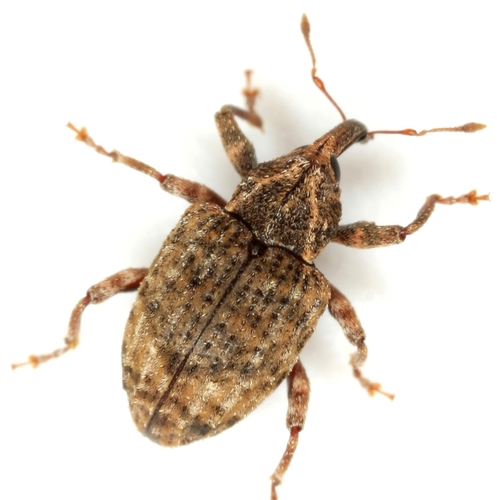
Ips typographus, the European spruce bark beetle, is a species whose adults are cylindrical, dark brown beetles that measure 4.2–5.5 millimetres (0.17–0.22 in) in length. When viewed from above, a large domed shield covers both the thorax and head; from a side view, the eyes, antennae, and mouthparts protrude below this shield. The upper half of the abdomen is covered by large elytra (wing-cases) marked with rows of small pits, and each elytron margin bears four spines. Yellow hairs grow along the sides of the body and between the elytra. This beetle reproduces in the inner bark (phloem) of its host trees. Eggs, larvae, pupae, and adults can all hibernate in their feeding and breeding galleries below the bark of host trees. Adults may also overwinter in forest leaf litter or under snow that is at least 20 centimetres deep. All overwintering life stages inside the bark of standing trees are killed by winter temperatures below -24°C. When spring air temperatures reach around 18–20°C, adults begin to fly, traveling up to half a mile to find a vulnerable host tree. Adults burrow through the weakened bark of the host to construct tunnels. A male excavates a mating chamber, where 1 to 4 females arrive to mate. After mating, each female builds a maternal gallery that runs parallel to the direction of the tree's phloem tubes, which is vertical on an upright tree. In warm conditions, a female lays around 80 eggs, placing one at a time in separate niches on either side of her maternal gallery; fewer eggs are laid in cold conditions. Adults release pheromones to attract more individuals to the host tree. Two to five weeks after infesting a tree, beetles may migrate to another host and repeat the full reproductive cycle. In far northern regions and mountains, there is typically only one generation per year; in lowland Europe, two generations are common, and up to three generations can occur in the warmest conditions. I. typographus eggs are whitish grey and less than 1 millimetre (0.039 in) long. Both larvae and pupae are whitish, and reach roughly the same final size as adult beetles. Larvae are cylindrical and legless, with brown heads and jaws. A larva excavates a side tunnel branching off from the maternal gallery, and feeds only on phloem, never tunneling into wood. If enough larvae sustain an attack on a single tree, the tree will eventually be girdled, which cuts off phloem flow and kills the tree. This species is distributed across Europe, excluding Ireland, Portugal, and the Caucasus; it is also found in Algeria, Turkey, Iran, Russia, northern China, Korea, Japan, and Kazakhstan, and has occurred transiently in Britain. It inhabits both lowland and upland forests. The high abundance of Norway spruce in European forests has made this tree the main host of the beetle. The beetle also attacks other tree species from the genera Picea (spruce), Abies (fir), Pinus (pine), and Larix (larch). Most recent invasive outbreaks of this spruce bark beetle have occurred primarily in fallen, diseased, or damaged Norway spruce. Though the beetle specializes on Norway spruce, it does not occur throughout the entire native range of the tree. One hypothesis states climate may have limited the species' ability to persist in the northernmost Norway spruce forests. Other researchers argue that beetle populations in these regions have active, directed host searching ability, but lack adaptations for long-range dispersal. Outbreaks of the European spruce bark beetle are major natural disturbances to European forests, comparable in impact to storm damage. Some scientists classify this species as a keystone species, because it has an unusually high number of ecological interactions with other community organisms, and alters its environment so drastically. Bark beetles of this species associate with fungi in the order Ophiostomatales; the most common associated species are Ophiostoma bicolor, O. penicillatum, Ceratocystiopsis minuta, and C. polonica, while O. piceaperdum occurs somewhat less often. Some of these associated fungi may help regulate the damage caused by the beetles. In contrast, C. polonica is a plant pathogen that can kill healthy trees by blocking the upward flow of water and causing tree foliage to wilt. It also leaves blue streaks that stain the wood, destroying its commercial value. The small pits on the beetle's elytra help carry fungal spores to uninfected trees, which may facilitate larger beetle outbreaks. Healthy host trees use defensive adaptations: they produce resin or latex, which contain insecticidal and fungicidal compounds that can kill or injure attacking beetles. However, when trees are stressed and during widespread outbreak conditions, beetles can overwhelm a tree's natural defenses. Woodpeckers can help regulate I. typographus populations in diverse coniferous forest landscapes; they feed on beetle larvae by splitting bark to reach the tunnels. I. typographus is somewhat larger than the related bark beetle Pityogenes chalcographus. The two species reduce direct interspecific competition by selecting different parts of a host tree based on their body size. I. typographus mostly occupies the lower parts of a tree with thicker bark, while P. chalcographus prefers higher parts with thinner bark, as it is outcompeted by I. typographus in thick bark. These bark beetles communicate with one another using semiochemicals, which are compounds or mixtures that carry chemical messages. They can also detect green leaf volatiles such as 1-Hexanol released by host trees. European spruce bark beetles are able to spread quickly across large areas. Long-distance movements have contributed to their invasion of northern Norway spruce forests. These movements are often triggered by environmental factors including severe storms, drought, or mass fungal infections that damage or kill host trees.