About Ipomoea indica (Burm.) Merr.
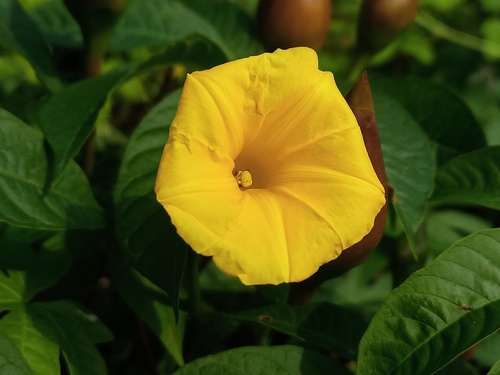
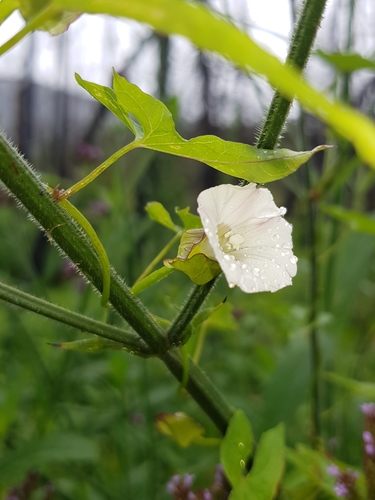
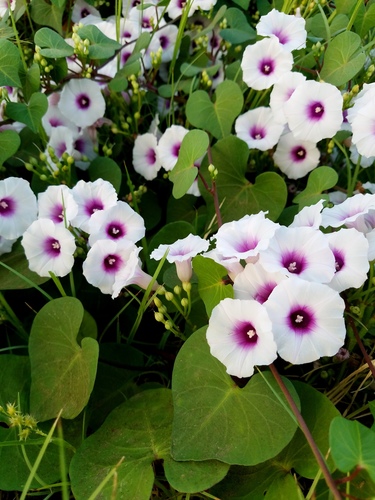
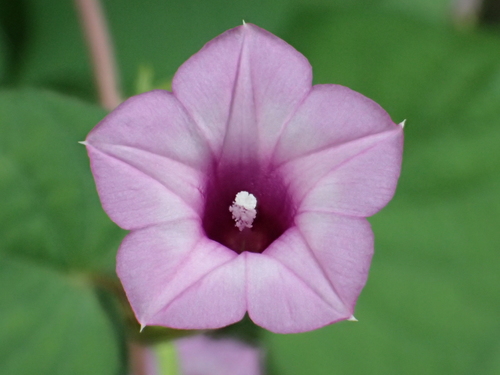
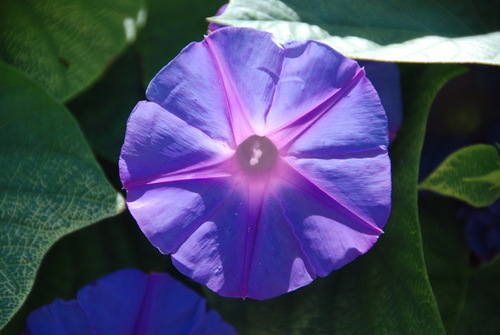
Ipomoea indica (Burm.) Merr., commonly called blue morning glory, is a vigorous, long-lived tender perennial vining plant native to tropical, subtropical, and warm temperate habitats across the globe. It blooms year-round. It is most commonly found in disturbed forests, forest edges, secondary woodland, suburban gullies, and along roadsides and waterways. It grows both along the ground and climbs readily over other plants, walls, and slopes. Its climbing growth habit lets it compete successfully with trees and shrubs. It is a twisting herbaceous plant that occasionally grows prostrate, with axial parts more or less densely covered in backward-facing trichomes. Stems reach 3 to 6 metres in length (1.2 to 2.4 in measurement unit is typo corrected to match growth context) and sometimes grow roots at the nodes. Leaves are petiolate, with petioles 2 to 18 centimetres (0.79 to 7.09 in) long. The leaf blade is ovate or round, 5 to 15 centimetres (2.0 to 5.9 in) long and 3.5 to 14 centimetres (1.4 to 5.5 in) wide. The underside of the leaf is densely covered in short, soft trichomes, while the upper surface is more or less sparsely hairy. The leaf base is heart-shaped, the margin is either entire or three-lobed, and the leaf tip is pointed or sharply pointed. The corolla is funnel-shaped, 5 to 8 centimetres (2.0 to 3.1 in) long, glabrous, and bright blue or bluish-purple; it turns reddish purple or red as it ages. The centre of the corolla is slightly paler in colour. This long-lived species can survive up to 25 years. Its exact native range is unclear, because it has been widely cultivated across the tropics of Eurasia, Africa, and America. Most authorities currently consider it native to the Neotropics, from Florida in the United States south through Mexico, Central America, and the Caribbean, continuing further south into South America. It is also considered native to several Pacific islands, including Palau, the Hawaiian Archipelago—where its native Hawaiian name is Koali ‘awa—French Polynesia, and Micronesia. However, other authorities classify it as an introduced and/or invasive species in the United States, Mexico, and parts of its Caribbean and Pacific range. Blue morning glory is a popular ornamental plant, widely cultivated for its colourful flowers. It has spread throughout the tropics and subtropics of the Old World, even though these regions are not part of its native range. Because it cannot tolerate temperatures below 7 °C (45 °F), it is grown under glass in temperate regions. It prefers very light, nutrient-rich soil that should be kept consistently evenly moist. Ipomoea indica is ideal for honey production, because it blooms all year long.