About Inula helenium L.
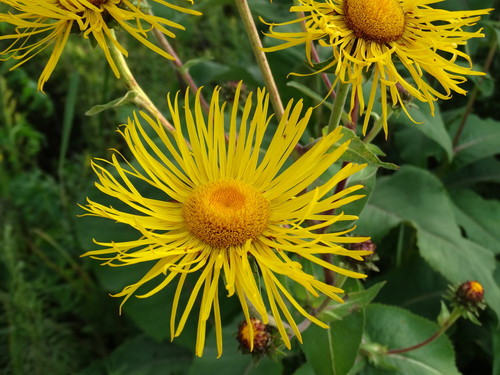
Elecampane (Inula helenium L.) is a rather rigid herb. Its stem grows to a height of approximately 90–150 cm (35–59 in). The leaves are large and toothed: lower leaves have stalks, while the remaining leaves clasp around the stem. Leaf blades are egg-shaped, elliptical, or lance-shaped, and can reach up to 30 cm (12 in) long and 12 cm (4.7 in) wide. The upper surface of leaves is green with light, scattered hairs, while the underside is whitish, covered by a thick woolly layer. Its flower heads are up to 5 cm (2 inches) wide; each head holds 50 to 100 yellow ray flowers and 100 to 250 yellow disc flowers. The root is thick, branching, and mucilaginous, with a bitter taste and a camphoraceous scent that has sweet floral undertones similar to violet.
This herb has been used since the time of Ancient Greece. In his *Historia Plantarum*, Theophrastus recommended using the plant in oil and wine to treat bites from vipers, spiders, and pine caterpillars. In the 1st century AD, the Roman cookbook *Apicius* describes using elecampane to test if honey is spoiled: the plant is submerged in the honey and then lit, and bright burning means the honey is considered good. Pliny mentioned the root in *Natural History* both as a medicine and as a condiment. In Medieval Europe, elecampane roots were candied and eaten as confectionery. It has been used in the production of absinthe in France and Switzerland. In England, it was formerly widely valued as an aromatic tonic and a stimulant for the secretory organs. It is noted in an 1817 New-England almanack as a treatment for hydrophobia when the root is bruised and used with a strong milk decoction. In herbal medicine, it is used as an expectorant and to treat water retention.