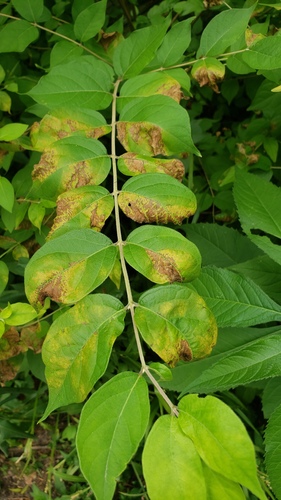
About Insolibasidium deformans (C.J.Gould) Oberw. & Bandoni
Insolibasidium deformans (published as (C.J.Gould) Oberw. & Bandoni) is a fungus species in the order Platygloeales. It is the only species contained within the monotypic genus Insolibasidium. This fungus parasitizes the leaves of multiple Lonicera species, and causes the disease honeysuckle leaf blight, which is commercially important for plant nurseries. At minimum, 18 known Lonicera species are recorded as hosts for Insolibasidium deformans. When it parasitizes host leaves, the fungus grows hyphae inside the leaf tissues, and produces basidia that push out through the leaf stomata. Under microscopic examination, the basidia are auricularioid, meaning they are tubular and have lateral septa. Leaves infected by this fungus first turn yellow, then turn brown, and eventually become dead and dry with visible brown patches. Infected leaves often develop rolling and twisting, and drop from the plant earlier than healthy leaves. This species is originally native to North America. It has been introduced to the United Kingdom, where honeysuckle leaf blight was first documented in 2000, and to Australia, where the disease was first observed in 2003. It has also been recorded as present in Germany, Poland, and New Zealand.

