About Iniistius pentadactylus (Linnaeus, 1758)
General Coloration
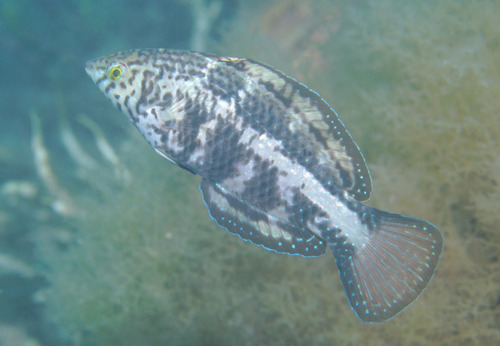
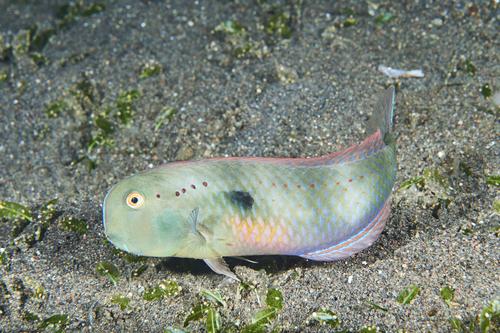
Iniistius pentadactylus is a pale-grey wrasse. Along the lateral line behind the head, it has several overlapping red spots that look black when viewed underwater. It often has a brown blotch directly behind the tip of the pectoral fin.
Female Coloration
Females do not have the lateral line spots, but they do have a large white area with red scale margins on their lower flanks.
Genus Morphology
All species in the genus Iniistius have highly compressed bodies and a steep forehead with a hard, knife-like edge. This edge lets them dive into sand when threatened, giving the group the common name razorfish.
Dorsal Fin Structure
This species has 9 spines in its dorsal fin; a notch separates the first two spines from the rest of the spines. The dorsal fin also has 12 soft rays, while the anal fin has 3 spines and 12 to 13 soft rays.
Maximum Size
The largest mature males of this species reach a total length of 25 centimetres (9.8 in).
Indian Ocean Distribution
Iniistius pentadactylus is distributed from the eastern coast of Africa, ranging from the Red Sea south to Mozambique, and extends eastward to Guam.
Pacific Ocean Distribution
In the Pacific Ocean, its range reaches north to the Ryukyu Islands and Ogasawara Islands, and south to the Great Barrier Reef and Christmas Island, Australia.
Habitat Preferences
This species lives on sandy substrates in coastal areas, and can also be found in regions with some sea grass or algae. It occurs at depths greater than 18 metres (59 ft).
Group Behavior
It is typically found in large, dispersed groups that frequent the upper slopes of sand and mud banks.
Territoriality
Males are territorial, and each male defends a territory that holds many females.
Burrowing Behavior
This species buries itself in sand to sleep safely at night. When threatened, it dives head-first into sand to hide, and may not emerge again for some time.
Diet
It feeds mainly on hard-shelled invertebrates, including molluscs and crustaceans.