About Imperata cylindrica (L.) Raeusch.
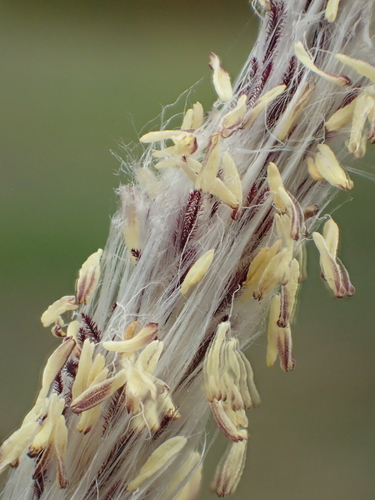
Imperata cylindrica, commonly called cogongrass, grows between 0.2 and 3 meters (1⁄2 to 10 feet) tall. It has firm stalks, with nodes covered in long white hairs. Clumps of cogongrass share an extensive rhizome network, which makes up 60% of the plant's total biomass. Rhizomes can grow as deep as 1.2 meters (4 feet), though a depth of 0.4 meters (1+1⁄2 feet) is typical in sandy soil.
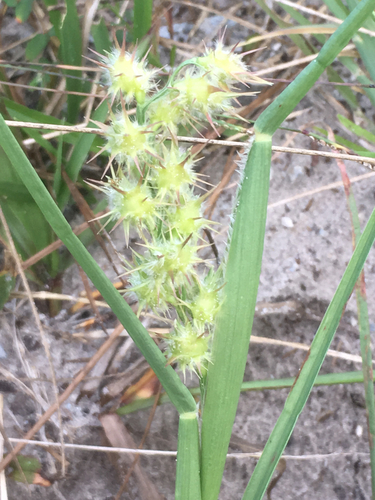
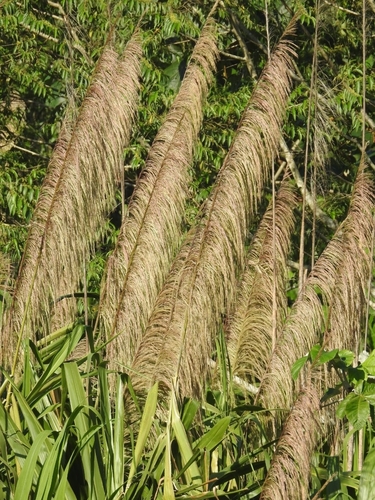
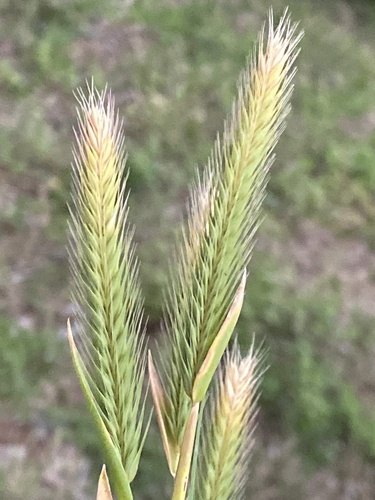
Near the base of the plant, leaves average around 2 cm wide and are 12 to 80 centimeters (4+1⁄2 to 31+1⁄2 inches) long. Leaves narrow to a sharp point at the tip, have finely toothed margins embedded with sharp silica crystals, and have a lighter-colored main vein that usually sits closer to one side of the leaf. The upper leaf surface is hairy near the plant base, while the underside is typically hairless. Cogongrass produces small flowers arranged on 0.5–3 mm long pedicels, held in narrow panicles that sit just above the stalks and can grow up to 28 cm tall.
Throughout southeast Asia, cogongrass is considered an excellent material for thatching roofs of traditional homes, and it is even cultivated as a crop for this purpose. It is widely planted as ground cover and for soil stabilization in beach areas and other regions prone to erosion. Additional uses include paper-making, thatching, and weaving into mats and bags. It is also used in traditional Chinese medicine. Several cultivars have been developed for ornamental garden use, including the red-leaved 'Red Baron', also called Japanese blood grass. Young cogongrass inflorescences and shoots can be eaten when cooked, and the roots contain starch and sugars.