About Imleria badia (Fr.) Vizzini
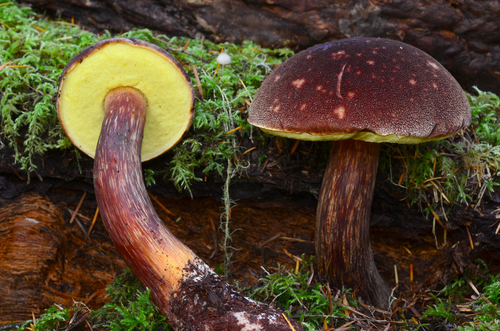
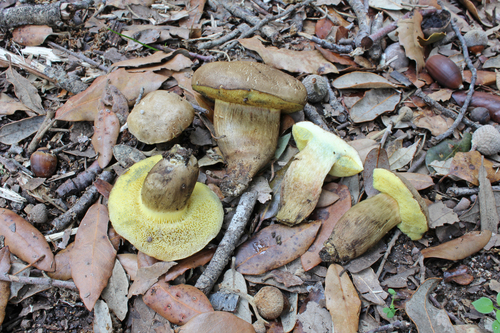
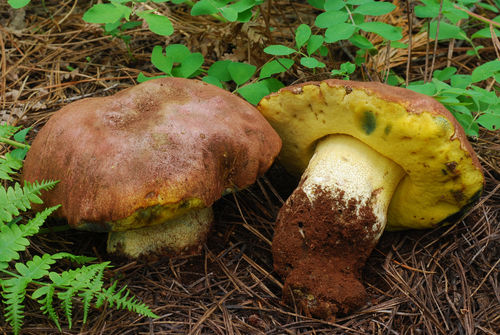
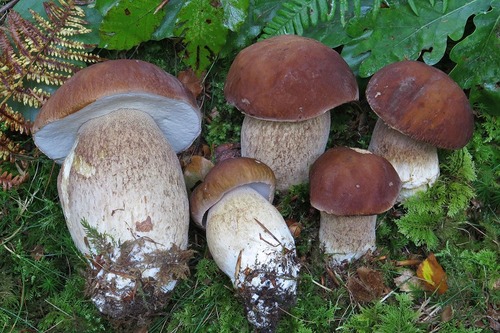
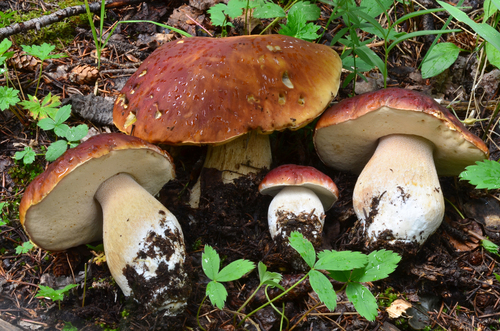
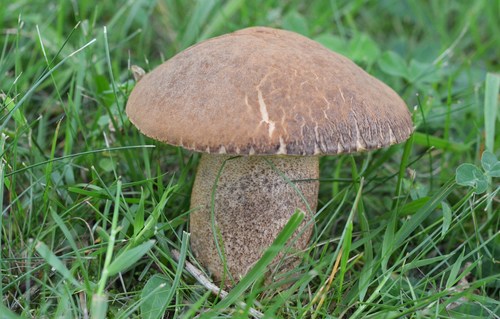
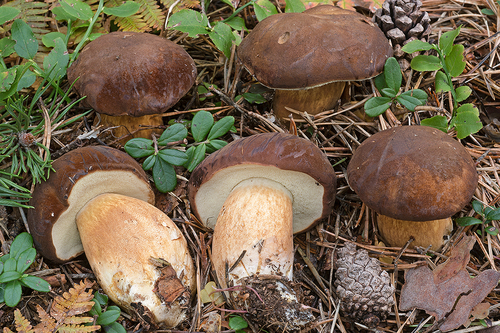
Imleria badia, commonly known as the bay bolete, has the following characteristics. Its fruit bodies have a chestnut to dark brown cap that starts nearly spherical in young specimens, then broadens and flattens to reach a maximum diameter of 10 cm (4 in). Young caps have an acute margin and a velvety surface; the surface becomes slightly sticky when wet or from age. The cap cuticle does not separate easily from the underlying flesh. On the underside of the cap, the pores start cream to pale yellow and turn greenish yellow or olive as they age. When bruised or cut, pores stain dull blue to bluish-grey, and can be easily removed from the flesh. Pores begin circular, become more angular with age, and number around 1 to 2 per millimetre. The tubes, connected to the pores, are 0.8–1.5 cm (3⁄8–5⁄8 in) long, and grow from adnate to depressed around the point where they attach to the stipe. Most of the mushroom's flesh is whitish, with some yellowish areas; under the cap cuticle, the flesh is brownish-pink or reddish brown. Initially firm, the flesh under the cap softens in older mushrooms. In some parts of the cap, such as the junction between the cap and stipe, the flesh stains pale blue when injured or exposed to air, especially in damp weather. This colour change is sometimes faint and not permanent, as the flesh eventually returns to its original colour. The stipe is 4–9 cm (1+1⁄2–3+1⁄2 in) long and 1–2 cm (1⁄2–3⁄4 in) thick. It is similar in colour to the cap but paler, and sometimes has a faint rose-coloured tinge. Its surface has faint longitudinal ridges, a fine powdery coating, and fine net-like reticulations at the apex. It often has whitish areas at both the base and the top, and white mycelium grows at the base. Unlike the bulbous stipes of many other boletes, Imleria badia has a relatively slim, cylindrical stipe. The stipe flesh becomes tougher with age. The mushroom's smell is described as fruity. The spore print of Imleria badia is olive to olive-brown. The smooth spores are somewhat oblong to slightly ventricose (fattened in the middle), and measure 10–14 by 4–5 μm. The four-spored spore-bearing basidia measure 25–35 by 8–10 μm. Pleurocystidia (cystidia on the tube faces) are fuse-shaped and ventricose, with dimensions of 50–60 by 10–14 μm. Two varieties are recognized: I. badia var. macrostipitatus differs from the main form by its grey-orange cap, shorter 5–7 cm (2–3 in) stipe, longer spores (15–18 by 4–5 μm), and longer pleurocystidia (30–55 by 10–14 μm). I. badia var. glaber has a smooth, glabrous stipe, plus smaller pleurocystidia (35–40 by 10–15 μm) and smaller cheilocystidia (25–30 by 9–12 μm). Several chemical tests can help identify this mushroom. A drop of ammonium hydroxide solution turns the cap cuticle greenish to bluish. Iron(II) sulphate solution turns the flesh dull bluish-green, while a drop of dilute potassium hydroxide turns the pores golden brown. Imleria badia is common in coniferous woodlands, and less common in mixed woodlands. Its range in Europe extends from the British Isles, where it is abundant from August to November, east to the Black Sea Region in Turkey. In Asia, it has been recorded from Jordan, mainland China, and Taiwan. In North America, it ranges from eastern Canada west to Minnesota and south to North Carolina, and fruits from July to November. It also grows in central Mexico. I. badia var. macrostipitatus occurs from eastern Canada south to Maine and New York state, while I. badia var. glaber is found in the Atlantic Maritime Ecozone of eastern Canada. Fruit bodies grow singly or scattered on the ground or on decaying tree stumps, and can be well hidden by pine needles and ferns. Fruiting usually peaks three to four days after rain during warm weather. They can grow prolifically, especially in humid, shady highland areas. This species is commonly found growing under white pine, spruce, and hemlock, and also occurs under deciduous trees, most often beech. It can also grow in grassy or mossy areas at or near forest margins. It does not grow on calcareous (chalky) soils. Imleria badia is predominantly a mycorrhizal species, though it has some saprophytic tendencies it may use in certain conditions. The ectomycorrhizae it forms with Norway spruce (Picea abies) have active hyphal sheaths and store more nitrogen, phosphorus, potassium, magnesium, iron, and zinc than many other mycorrhizal types. This indicates the fungus is well adapted to acidic forest stands, and its mycorrhizae are very efficient at taking up and storing macronutrients. Ectomycorrhizae formed with Monterey pine (Pinus radiata) have also been documented. I. badia fruit bodies are less affected by insects than other boletes. Orbatid mites including Carabodes femoralis, Nothrus silvestris and Oribatula tibialis eat the fruit bodies, as do squirrels. Several microbial pathogens can damage fruit bodies and have impacted populations in China: these include soft rot caused by Pseudomonas aeruginosa, and black mould caused by species of Mucor, Sepedonium, Paecilomyces, and Diasporangium. Imleria badia is often considered a less desirable alternative to the cep (Boletus edulis), but is still rated a high-quality edible mushroom by some authors, including Antonio Carluccio. In central Mexico, it is collected from Izta-Popo Zoquiapan National Park and sold in neighbouring local markets. It may cause an allergic reaction in some people, and the blue bruising discolouration can be offputting, though the staining disappears from white flesh during cooking. Its flavour is milder than that of Boletus edulis. Younger specimens are best for eating, but more mature specimens can be cut up and dried. Because the pores easily absorb water, wiping rather than washing is recommended before cooking. Unlike most boletes, I. badia can be eaten raw, though only young mushrooms are recommended for this use. It can also be fried in butter, or added to meat or fish recipes. Mushrooms may be frozen, dried, or pickled in cider vinegar, wine, or extra virgin olive oil for later use in sauces or soups. The fruit bodies can also be used to make mushroom dyes. Depending on the mordant used, colours ranging from yellow, orange, gold, to green-brown can be produced; without a mordant, a yellow colour is obtained.