About Ilex vomitoria Aiton
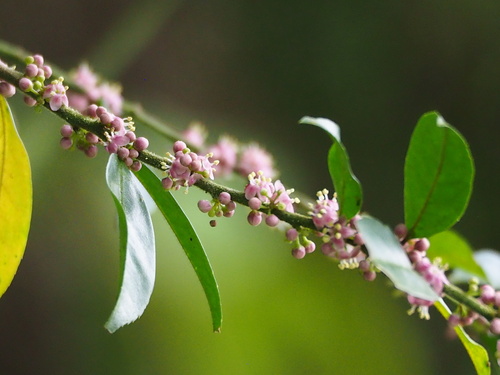
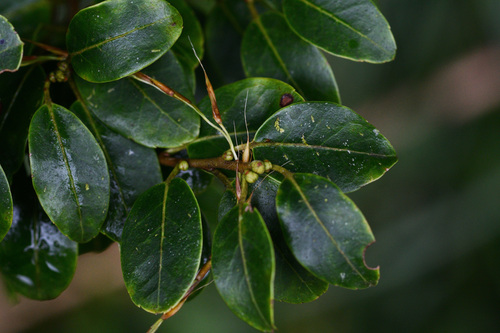
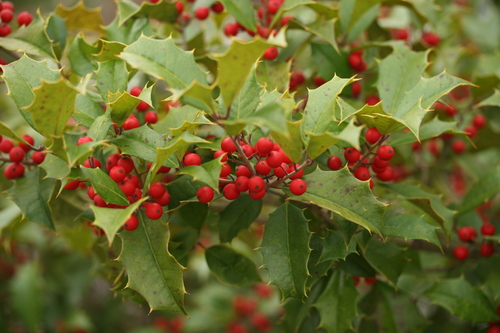
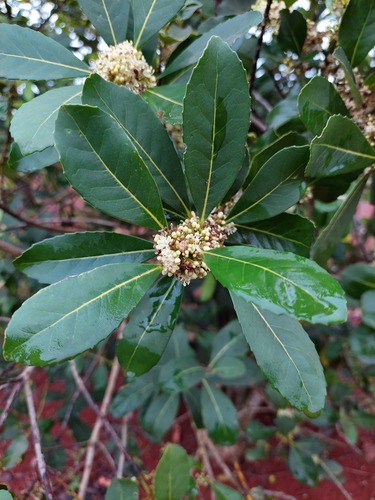
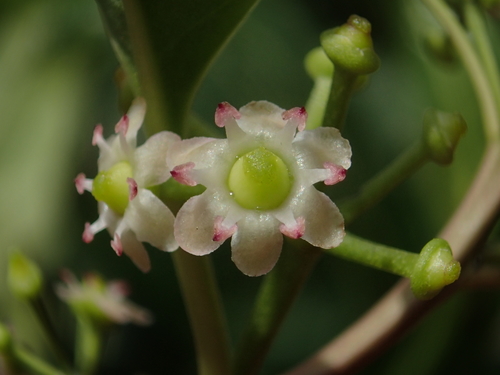
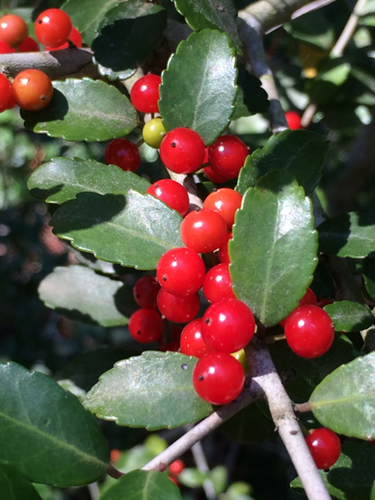
Yaupon holly, scientifically named Ilex vomitoria Aiton, is an evergreen shrub or small tree that grows 5–9 meters tall. It has smooth, light gray bark and slender, hairy shoots. Its leaves are arranged alternately; they range from ovate to elliptical in shape, with a rounded apex and crenate or coarsely serrated margins. Individual leaves measure 1–4.5 cm long and 1–2 cm broad, with a glossy dark green upper surface and a slightly paler lower surface. Its flowers are 5–5.5 mm in diameter, with a white four-lobed corolla. The fruit is a small, round, shiny drupe, 4–6 mm in diameter, most often red, and occasionally yellow. Each fruit contains four pits, which are dispersed when birds eat the fruit. This species can be told apart from the closely related Ilex cassine by its smaller leaves with a rounded, rather than acute, apex.
I. vomitoria is native to the southeastern and south-central United States, where it ranges from the Eastern Shore of Virginia south to Florida, and west to Oklahoma and Texas. It is also native to Cuba, and a separated disjunct population grows in the southern Mexican state of Chiapas. It typically grows in coastal areas on well-drained sandy soils, and can be found on the upper edges of brackish and salt marshes, sandy hammocks, coastal sand dunes, inner-dune depressions, sandhills, maritime forests, nontidal forested wetlands, well-drained forests, and pine flatwoods.
The fruit of I. vomitoria is an important food source for many bird species, including the mottled duck, American black duck, mourning dove, ruffed grouse, bobwhite quail, wild turkey, northern flicker, sapsuckers, cedar waxwing, eastern bluebird, American robin, gray catbird, northern mockingbird, and white-throated sparrow. Mammals that consume its fruit include the nine-banded armadillo, American black bear, gray fox, raccoon, and skunk. White-tailed deer browse its foliage and twigs.