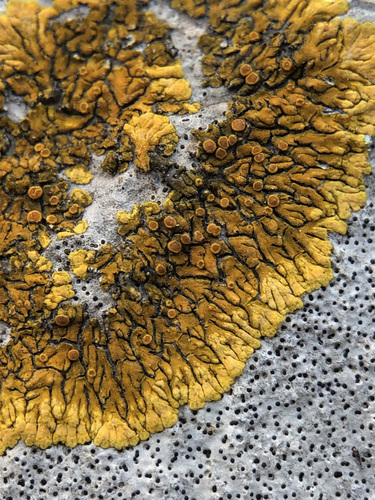
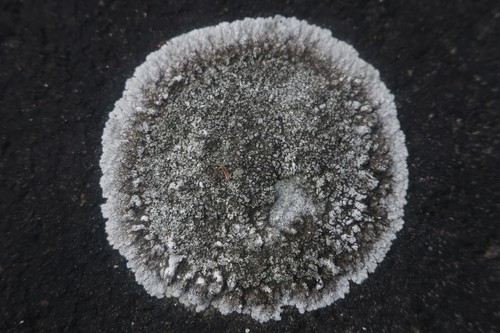
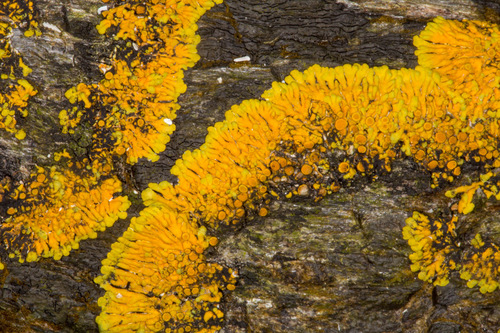
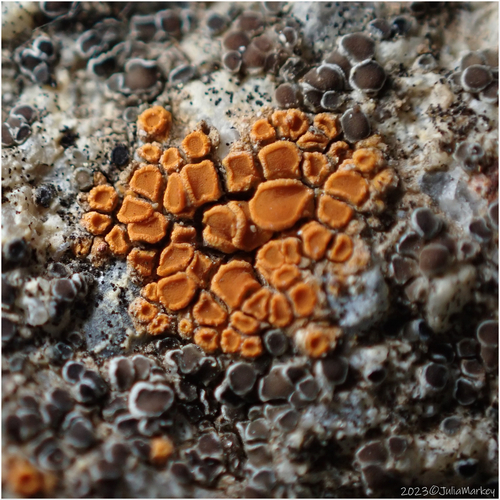
About Igneoplaca ignea (Arup) S.Y.Kondr., Kärnefelt, Elix, A.Thell, Jung Kim, M.H.Jeong, N.N.Yu, A.S.Kondr. & Hur
The genus Igneoplaca has a crustose thallus made up of red to orange lobes. Its cortical layer is paraplectenchymatous, meaning it is a fungal tissue with a cellular structure that is superficially similar to the parenchyma of vascular plants. The medulla of this genus is prosoplectenchymatous, a fungal tissue with a structure that looks superficially like the collenchyma of vascular plants. The apothecia of the genus are lecanorine, with a paraplectenchymatous true exciple. Lichens in this genus contain anthraquinones that belong to the parietin chemosyndrome. Igneoplaca is similar to the genus Calogaya, but Calogaya does not have a prosoplectenchymatous medulla. Igneoplaca ignea is found in Baja Mexico and southern California. It grows on rock in sunny locations, and prefers to grow on acidic rock types including volcanic rock, schist, pebble, shale, and granite.