About Idia americalis Guenée, 1854
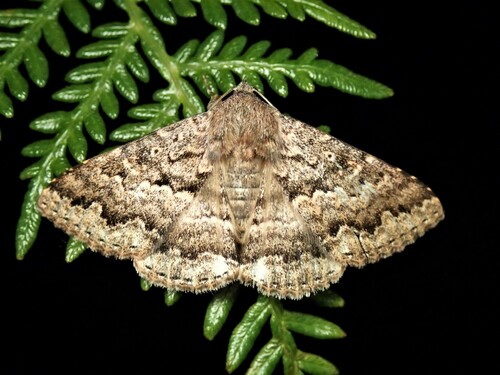
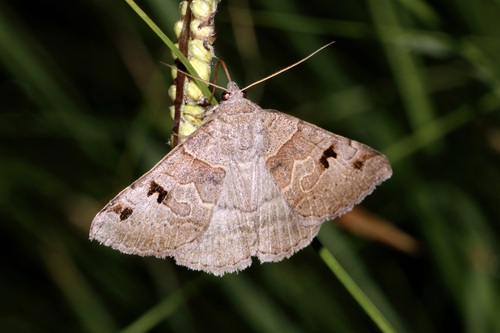
Idia americalis, commonly known as the American idia or American snout, is a litter moth belonging to the family Erebidae. This species was first formally described by Achille Guenée in 1854. It is commonly found in moist forests across North America, with its range extending from southern Canada to Florida and Texas. It is a nocturnal species, and can be attracted to sugar baits and light traps. The forewings of the American idia range in color from grey to beige or light brown, growing darker toward the outer wing margin. Dark scalloped lines cross the forewings laterally, and a dark terminal line sits at the base of the wing fringe. All individuals have a small bronze or brown spot near the edge of the forewing. The hindwings are a lighter grey than the forewings, and also bear darker scalloped lines. Darker individuals can be dark grey or brown overall. The thorax and abdomen have smooth scaling, and the tibia is hairless. Females have simple antennae, while males have biciliate antennae; aside from this difference, the two sexes are similar in appearance. The caterpillar is brown with dark brown spots and a black head, and has small white hairs along its sides. The adult wingspan ranges from 20 to 30 mm. Adults are active between May and October, and this species can produce two or more broods per year. This species can be distinguished from similar species like the common idia by a row of dark marks on the anterior forewing. Specimens of Idia americalis may be mistaken for a small geometrid moth. The larvae feed on lichen and detritus, including dead leaves, and may act as detritivores within ant nests. Adult moths often feed on lichens growing on tree trunks.