About Idaea subsericeata (Haworth, 1809)
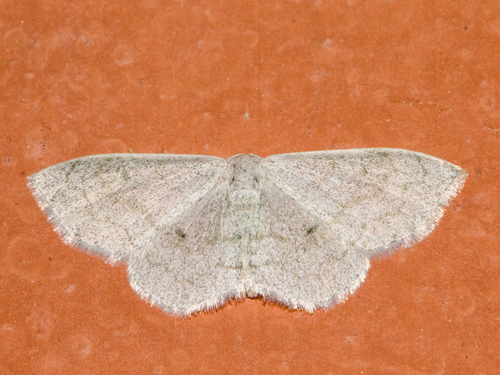
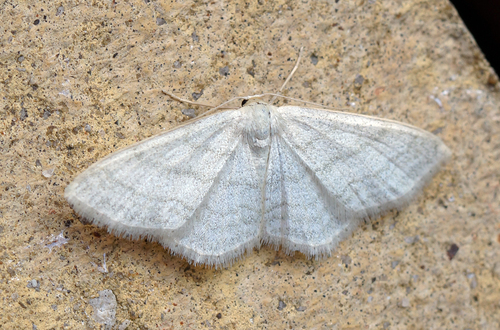
This species, Idaea subsericeata, has white wings with a strong silky gloss and grey lines. The lines are not often strongly expressed, but are usually all present: five on the forewing and four on the hindwing. The outermost line, which forms the distal shading of the subterminal area, is the most frequently absent. All lines except the median are slightly wavy and parallel to the distal wing margin. On the forewing, the median line is usually somewhat oblique, but it is occasionally almost parallel to the other lines. On the hindwing, the median line runs straighter across the wing, rather than following the curve of the strongly convex distal margin. Cellspots and a terminal line are absent, or rarely the cellspots are present and minute. The fringe usually has a series of minute black dots at its base; these dots are sometimes partially, and more rarely entirely, absent. The underside of the forewing often has a smoky suffusion, either on the basal area or across the entire wing; the median and postmedian lines are present and often well developed, and a small discal dot is present. The underside of the hindwing is white, with a discal dot and a postmedian line. In males, the antennal ciliation is only slightly longer than the diameter of the antennal shaft, and the hindtarsus is short. Overall, this is not an extremely variable species except for size. It does show a great deal of trivial variation in traits such as the absolute and relative strength of the different lines, how close the inner subterminal line is to the postmedian line, and the degree of suffusion on the wing undersides. Second-brood specimens are smaller, average whiter on the wing underside, and sometimes have rounder wings. The oval egg has a depression in the middle of its upper end, and its surface has small, flat recesses. It is initially light yellow, and later turns bright orange with red spots. The caterpillar is relatively slender, with a slight diameter decrease toward the front end. Its color ranges from whitish grey, grey, and grey-brown to brown, and it has a slightly reddish dorsum. Its surface appears wrinkled and is covered with fine warts. The dorsal line is relatively narrow and dark, and is lined with dark dots. The lateral lines are yellowish white. The large head has a notch in the middle of its apex. The pupa ranges from blackish brown to golden brown, with greenish wing sheaths. It is 9 millimeters long and 2.9 millimeters in diameter. The cremaster is about as long as it is wide, and is covered with four pairs of hook-shaped curved bristles. This species has a wingspan of 22–25 mm. Adults fly in one generation from June to July. The larvae feed on low growing plants including knotgrass, dandelion, and chickweed. It prefers warm slopes, sun-exposed forest edges and clearings, hedgerow rows, dry grass, fallow fields, abandoned vineyards, and dry salt marshes near the coast.