About Idaea rusticata (Denis & Schiffermüller), 1775
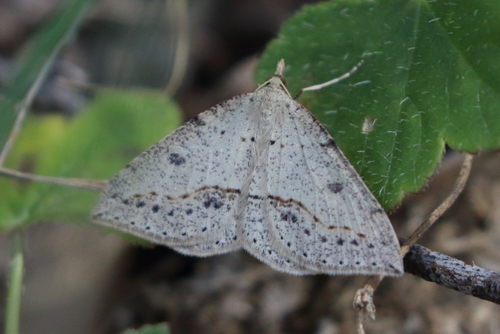
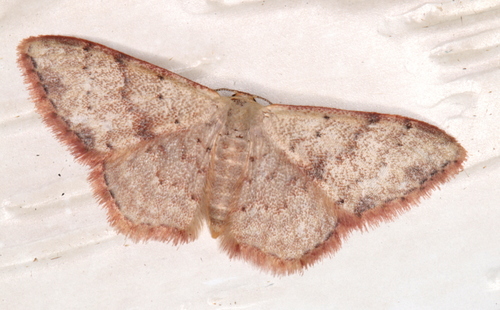
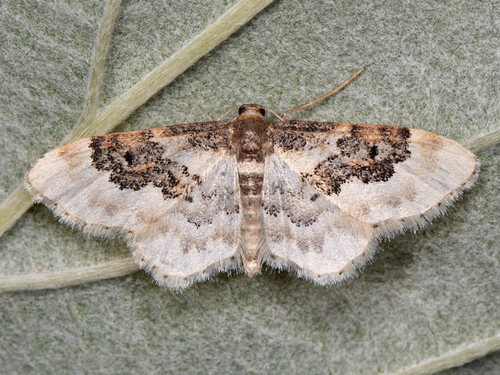
Idaea rusticata, first described by Denis & Schiffermüller in 1775, has a wingspan of 19–21 mm, with forewings measuring 9–11 mm in length. All wing edges are fringed. The moth’s base wing colour is whitish or cream, sometimes with a very faint light brownish tone. The upperside of the forewings features a dark brown to red-brown transverse marking in the central wing field, which runs from the leading to the trailing edge of the wing. This marking always contains a distinct point-shaped black spot. The upperside of the hindwings is light grey, marked with darker grey transverse lines. The base of the hindwing’s anterior margin is darkened brown, and the discal cell of the hindwing also holds a small black spot. The eggs of this species are oval and relatively small. Mature caterpillars are rather short, tapering toward the hind end, and show clear body constrictions. Their body colour is grey brown or brown, with a narrow light line running along the back. The abdomen is brightly coloured, while the head is small and solid black. The pupa is light brown with a smooth, glossy surface. This species is distributed across most of Europe, the Near East, and North Africa. Starting from the Balkan Peninsula, its range extends across the Palearctic region through Ukraine, southern Russia, and Asia Minor to the Caucasus; from the Caucasus it continues through northern Iran, Afghanistan, Turkmenistan, and Kyrgyzstan into the Central Asian mountains, reaching as far east as Mongolia. In Britain, this moth recorded the largest percentage increase in abundance among all British moth species between 1968 and 2007, and expanded its range beyond the area around London. These moths typically inhabit wastelands, open areas, parks, and exposed gardens.