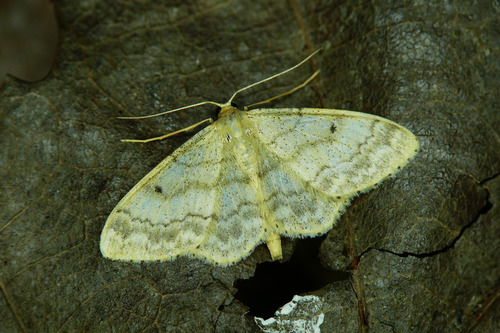
About Idaea biselata (Hufnagel, 1767)
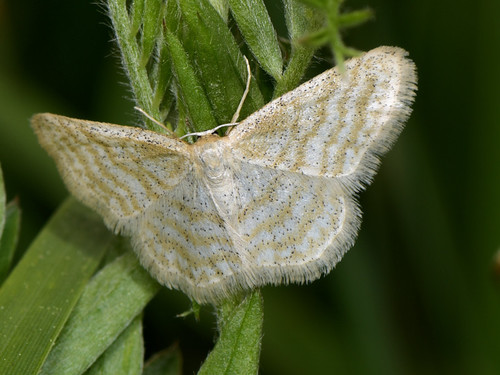
Idaea biselata (Hufnagel, 1767) is a small species, with a 22–25 mm wingspan, that is easily overlooked. Its wings are creamy white with darker bands, and each wing bears a small black discal spot. The species' basic colouring and pattern vary relatively little. Its ground colour ranges from yellowish white to slightly brownish white, while its pattern elements are brown to dark brown. On the forewings, the interior crossline is the most clearly visible, and the outer crossline is usually significantly developed. A pale wavy line lined with darker colour on its inner and outer sides is located in the marginal field. Both forewings and hindwings have black discal spots: on the forewings these spots are basal to the middle crossline, while on the hindwings they are distal to the interior crossline. Marginal stains are dark brown but are dimly developed. The larva is long and thin, with a few short setae, brownish grey with a white side stripe. This species is widespread from the British Isles across western Europe, east to the Urals. In northern Europe, its range extends approximately to central Fennoscandia. In the south, its range reaches central Portugal, Corsica, the northern Apennines and northern Greece. Isolated occurrences are recorded from Calabria and the Peloponnese. Outside of Europe, it is found in the Caucasus, Transcaucasia, northern Turkey, Siberia, northern Kazakhstan, and the Russian Far East. The subspecies Idaea biselata extincta (Staudinger, 1897) occurs in Korea and the Ussuri region. In the Alps, this species can be found at elevations up to approximately 1,700 metres above sea level. South of the Alps, it occurs between 600 and 1,500 metres above sea level, and is rarely found below this elevation range.