About Idaea aversata (Linnaeus, 1758)
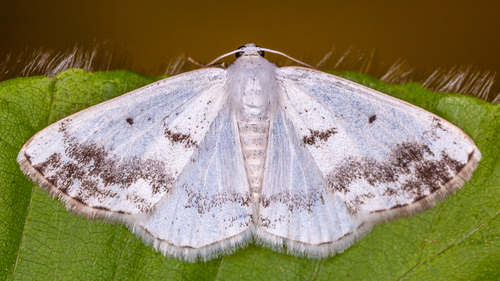
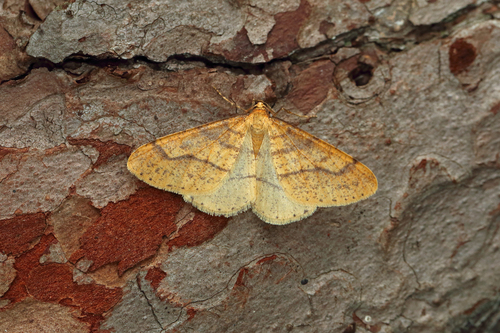
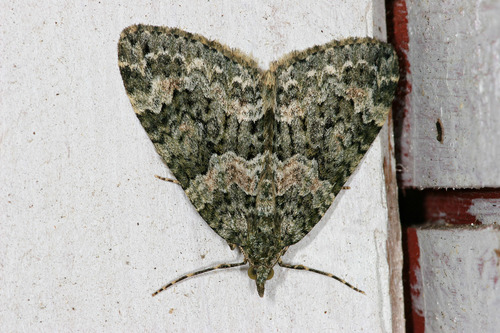
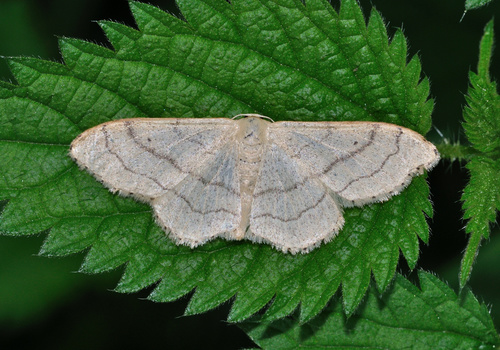
Idaea aversata (Linnaeus, 1758) is a moth species with a wingspan of 30–35 mm. Its distinctive outline is commonly seen at lighted windows. The species' wings are buff or cream with dark fasciae (bands). Two equally abundant main forms exist: one has darker shading between the central fasciae, while the other, designated ab. remutata, does not. The ground colour of the wings ranges from whitish yellow to ochre, and some specimens have red-orange colouring. The pattern elements are dark brown and clearly defined. Forewings have three crosslines, and hindwings have two crosslines. The outer cross line forms a significant outward angle near the costa. The area between the middle and outer cross line is dark brown. Discal flecks are small and inconspicuous, and may be absent entirely. Small marginal dots lie along the outer edge, and can almost form a narrow marginal line. For additional details, see Prout and Hausmann.
The larva is moderately stout, tapering toward the anterior end and somewhat flattened, with a projecting, puckered lateral ridge. The head is small and reddish brown, thickly dusted with black. The body is rugose, with transversely folded skin, and is dull brown. The posterior four segments are paler with an ochreous tinge. The dorsal line is whitish and indistinct, with dark bordering on the thorax and the last four abdominal segments, and is accompanied by brown V-shaped markings on intermediate segments. There are one or two white dorsal spots, and the subdorsal line is indistinct. The lateral line is whitish ochreous, with a dark underside. It has a blunt pale wedge-shaped blotch on each segment that contains two brown lines, followed by a smaller blotch that holds a grey V.
The pupa is smooth but not glossy, rather blunt at the anterior end. It is pale reddish brown, darker on the dorsal side and at the segmental incisions. The wings are greenish, and the cremaster is dark brown.
This species is abundant across Europe, the Near East, North Africa, and the entire Palearctic realm. There are very few records from the Iberian Peninsula and the Balkan Peninsula. Its northern range boundary runs through northern Sweden and northern Finland, and it is absent from the northernmost parts of Russia and a few areas of Russia northwest of the Caspian Sea. In North Africa, specifically eastern Algeria and Tunisia, a smaller separate subspecies, Idaea aversata indeviata Prout, 1935, occurs. Outside of Europe, the species' distribution extends from northern Turkey to the Caucasus, and from there through Central Asia, Siberia, and northeast China to Japan. The population occurring in Japan is recognized as the subspecies Idaea aversata japonica Inoue, 1955. A small, isolated population in southern Turkey is a notable occurrence.