About Ictinia mississippiensis (A.Wilson, 1811)
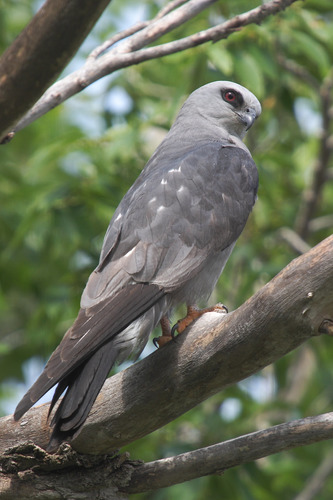
Physical Description: The Mississippi kite (Ictinia mississippiensis) is a medium-sized bird of prey. It measures 12 to 16 inches (30 to 40 cm) in length, with an approximate wingspan of 3 feet (90 cm). Adult Mississippi kites have light grayish-blue plumage, darker gray on the head, and a pale underbelly. Their long, deeply forked tail is an adaptation that improves flight agility. The species also has bright red striking eyes that give it excellent vision to locate prey while flying. Range and migration: The Mississippi kite's summer breeding range covers the Central and Southern United States, with the southern Great Plains recognized as a stronghold for the species. Sightings are regularly recorded across multiple U.S. states, including Florida, Kansas, Louisiana, Missouri, Oklahoma, Tennessee, Texas and Virginia. During the early 21st century, the species' breeding range has expanded; Mississippi kites are now regularly documented from Southern California to southern New England. In 2008, a breeding pair successfully raised chicks near Newmarket, New Hampshire, and a pair was observed breeding in Ohio in 2007. The species has also been recorded as far north as Canso, Nova Scotia. The Mississippi kite's range has expanded westward because planted shelterbelts (similar to hedgerows) in grassland habitats provide the birds with shelter and food. For the winter, the Mississippi kite migrates to subtropical and temperate regions of South America, mostly northern Argentina and southern Brazil. It has also been recorded in Belize, Costa Rica, El Salvador, México, and Panamá. Mississippi kites normally migrate in groups of 20 to 30 birds, though exceptions such as mixed flocks do occur. Groups as large as 10,000 individual birds have been observed, for example at Fuerte Esperanza, Argentina. Food and feeding: The Mississippi kite's diet is mostly made up of larger invertebrates and insects, which it captures while in flight. Seasonally it feeds on a variety of insects including cicadas, crickets, grasshoppers, locusts, and other crop-damaging insects, making it agriculturally and economically beneficial to humans. Like most raptors, the Mississippi kite is an opportunistic hunter, and it also preys on small vertebrates including passerine birds, amphibians, reptiles, and small mammals. It typically hunts from a low perch before chasing prey, and eats the captured prey while still in flight. Mississippi kites often fly around herds of livestock or grazing wild ungulates such as bison or wapiti, to catch insects that are stirred up from the ground.