About Icteria virens (Linnaeus, 1758)
When classified as part of the New World warbler family Parulidae, the yellow-breasted chat (Icteria virens) is the largest parulid species. It often weighs more than twice as much as other parulid species. This species measures 17 to 19.1 cm (6.7 to 7.5 in) in total length, has a wingspan of 23 to 27 cm (9.1 to 10.6 in), and has a body mass ranging from 20.2 to 33.8 g (0.71 to 1.19 oz). Standard measurements are as follows: wing chord 7.1 to 8.4 cm (2.8 to 3.3 in), elongated tail 6.9 to 8.6 cm (2.7 to 3.4 in), relatively long heavy bill 1.3 to 1.6 cm (0.51 to 0.63 in), and tarsus 2.5 to 3.1 cm (0.98 to 1.22 in).
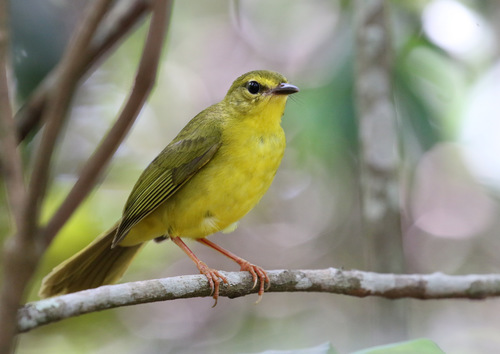
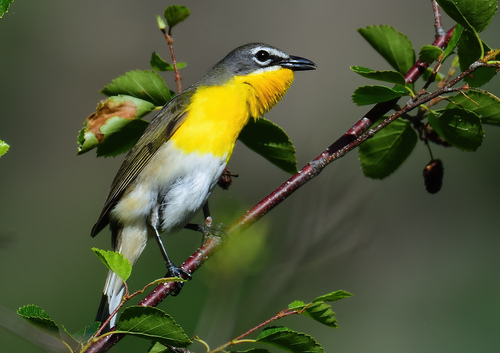
Yellow-breasted chats have olive-colored upper body parts, white bellies, and bright yellow throats and breasts. Their distinctive features include large white eye rings and blackish legs, and this species is not easily confused with any other bird visually. Its song is an unusual, variable mix of cackles, clucks, whistles, and hoots, while its calls are harsh 'chak' notes. Unlike most warblers, this species is known to mimic the calls of other birds. Less experienced field birdwatchers sometimes miss yellow-breasted chats because they mistake the chat's song for that of grey catbirds or brown thrashers; these species share similar habitat preferences and skulking habits, and are generally much more abundant. Yellow-breasted chats are most conspicuous during the breeding season, as they typically sing from exposed perches and will even fly in open areas while producing their gurgling songs.
The yellow-breasted chat occurs across North America. It breeds from the southern plains of Canada to central Mexico, and most individuals migrate to Mexico and Central America to overwinter, though some stay through winter in more northerly coastal areas. This species lives in areas with abundant dense shrubbery; its modern habitat often includes abandoned farmland and other rural areas where overgrown vegetation grows densely.
Yellow-breasted chats are omnivorous birds that forage in dense vegetation. They feed mostly on insects and berries, including blackberries and wild grapes. They prey on moderate-sized insects such as grasshoppers, bugs, beetles, weevils, bees, wasps, tent caterpillars, ants, moths, and mayflies, gleaning these insects from dense vegetation. Other invertebrates, including spiders, are eaten occasionally. Uniquely for a passerine of its size, the yellow-breasted chat sometimes grips food with its feet before eating.