About Ichneutica skelloni
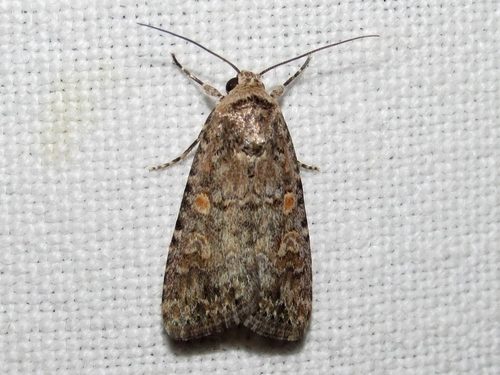
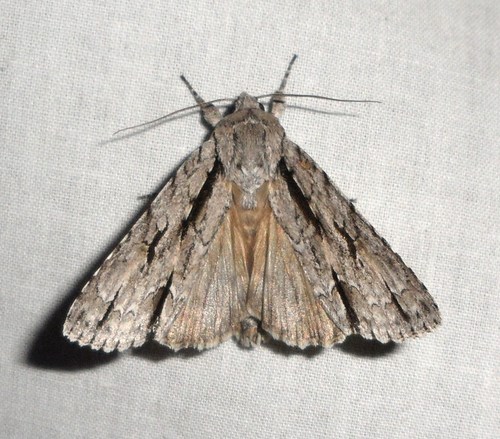
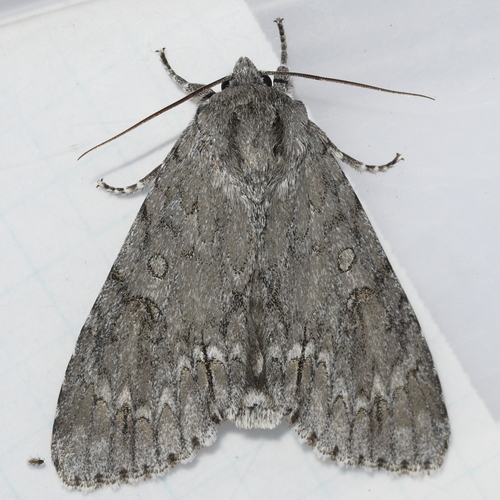
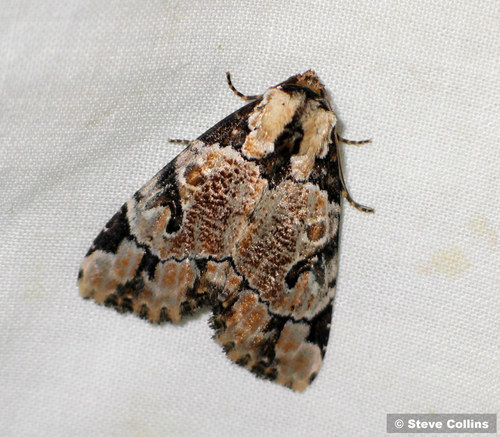
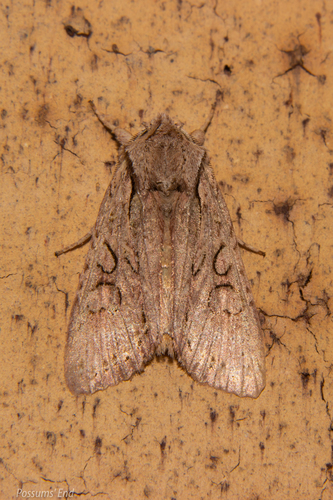
Its scientific name is Ichneutica skelloni. Butler originally described this species as follows: Primaries (forewings) above are laky-brown; a broad longitudinal internal sap-green streak, through which the submedian vein passes, interrupted near the base by an oblique B-shaped black patch; an oblique abbreviated black dash lies near the base of the interno-median area; discoidal and submedian spots are bordered with pale green, edged with black; the discoidal area is dark brown, and the "orbicular" spot matches this colour, is slightly oblique and almost reniform; the "reniform" spot is pale laky-brown with a curved blackish internal stripe; the submedian spot is obtusely hexagonal and laky-brown; the two central lines are slender, black, opposed, dentate-sinuate, and not distinctly traceable above the median vein; the submedian line is black, with a white inner border bounded within by sap-green and dark brown spots or patches, and is irregularly dentated, similarly to H. pisi; it has the usual costal markings. Secondaries (hindwings) are pinky-brown, with a diffused dusky border that encloses an ill-defined abbreviated sinuated whitish streak; the abdominal border is broadly fringed with pinky-whitish; the outer margin fringe is narrow, yellowish, tipped with dark brown. The body is rufous-brown, varied with pale greenish and whity-brown scales; the collar has the usual bisinuated blackish line. The undersides of the wings are pale sericeous pinky-brown, with blackish discocellular spots and a brown discal line; the underside of primaries has a pale submarginal line; the underside of secondaries has an indistinct greyish submarginal streak. The underside of the body is dull laky-brown, the pectus is slightly greyish, and the venter has a lateral black line. The wing expanse of the original described specimen is 1 inch 6 lines. When this species was reinstated by Hoare, it was noted to be extremely variable in size, colour and wing patterns on both fore and hind wings, the length of pectinations on male antennae, and even genitalia. It includes three distinct regional forms: the larger, more colourful patterned form found in Westland and Fiordland, the medium-sized form found from Wellington down to Stewart Island, and the smaller form found in Dunedin and Southland. Hoare argues that because variation in this species is continuous, all previous attempts to split it into multiple species have failed. The wingspan of adult males of this species ranges from 32 to 40 mm, while for adult females it ranges from 36 to 44 mm. All forms of this species can be visually distinguished from I. insignis: male I. skelloni have longer pectinations on their antennae, the black markings on the subdorsal portion of the forewings are shorter and broader in appearance, and there are differences in male genitalia between the two species. Some forms of I. skelloni may also be confused with I. scutata and I. pelanodes. This species is endemic to New Zealand. It has been confirmed to occur only in the Wellington region of the North Island, but is widespread across the South Island. It is also found on Stewart Island. George Hudson recorded the species as present in Hastings, but Hoare states this record requires further investigation. This species inhabits forest and shrubland habitat.