About Ichneutica omoplaca
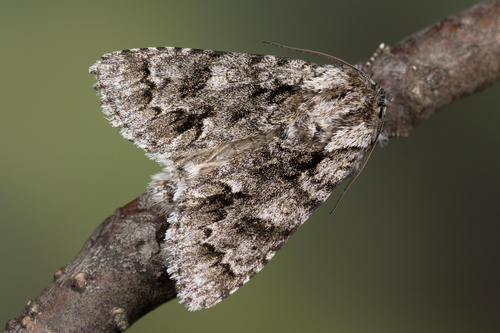
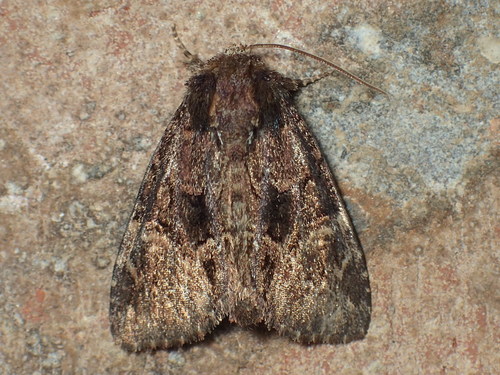
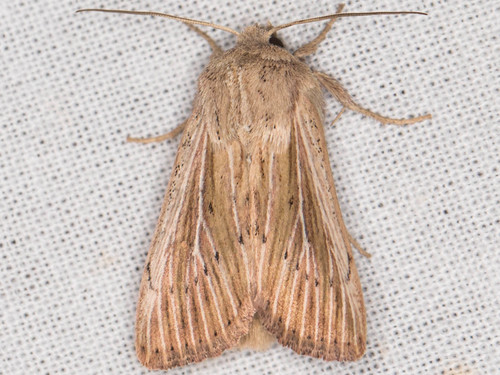
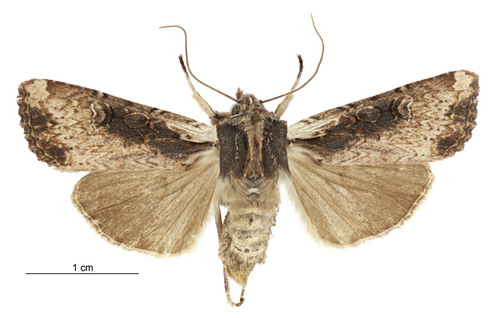
Meyrick described Ichneutica omoplaca as follows. Both male and female moths have a body length of 40–41 mm. The head, palpi, and thorax are dark reddish-fuscous, sometimes with a blackish tinge. The thorax has a rather large double anterior crest, an angulated black line that is ochreous-margined along its anterior edge, and ochreous-whitish coloring at the apex of its anterior angles. The antennae are fuscous; in males, they are submoniliform and moderately ciliated. The abdomen is grey, with reddish-whitish tufts. The legs are reddish-fuscous mixed with blackish; the anterior pair is ochreous-whitish, with the three apical joints of the tarsi being black. The forewings are moderately dilated, with an almost straight costa, obtuse apex, and a waved, obliquely rounded hind margin. They are reddish-fuscous, with a short black median streak extending from the base, margined above with ochreous-white. The area between this streak and the costa is marked with suffused ochreous-whitish lines. In one specimen, a blackish suffusion extends from the base of the inner margin obliquely to the orbicular and reniform spots, and the space between this suffusion and the subterminal line is suffused with pale whitish-ochreous. The orbicular and reniform spots are blackish-fuscous, black-margined, and connected by a blackish-fuscous spot. The orbicular is large and roundish; the reniform has a white outer edge. The claviform spot is small, suboval, and blackish-fuscous. The lines on the forewing are indistinct; the subterminal line is obscurely paler or barely traceable, with two somewhat acute dentations below the middle. The hind marginal space is mixed with blackish-fuscous, and the cilia are reddish-fuscous mixed with blackish. The hindwings are fuscous-grey, and their cilia are grey-whitish with a grey line. The adult male of this species has a wingspan between 31 and 41 mm, while the adult female has a wingspan between 33 and 43 mm. This species is variable, but its key diagnostic feature is the pale ochreous to white coloring between the basal streak and the costa, which is made more visible by the darker ground color of the forewing. Where contrast is lower, this species may be confused with Ichneutica lindsayorum. I. lindsayorum typically has a much lighter thorax, as well as a broader forewing with a more arched costa. This species is endemic to New Zealand. It is widespread from the Bay of Plenty in the North Island down to Southland in the South Island, and specimens have also been collected from the Auckland Islands. It has not been recorded from the northern part of the North Island. It occupies a variety of habitats, including beech forest clearings and tussock grasslands.