About Ichneutica arotis
Scientific name: Ichneutica arotis
Hudson described the eggs of this species as follows: Eggs are laid upright, are almost round, flattened underneath, and white when first laid. They have many prominent longitudinal ribs, connected by a series of transverse striations. As the egg develops, the micropyle and the ring surrounding it turn brown.
Hudson described the larvae of this species as follows: A fully grown larva reaches a length of approximately 1 13/16 inches, or 45 mm. Larvae are cylindrical and moderately stout, tapering sharply at both ends, with the strongest taper at the posterior end. The general body color is dull reddish-ochreous, marked with numerous darker, slightly wavy longitudinal lines. The head is ochreous with fine blackish markings. A double, slender brownish-red dorsal line with a pale interspace is very conspicuous; a similar but slightly fainter subdorsal line is also present. The lateral area is darker due to a dense covering of numerous irregular brownish strigulae; a row of fairly conspicuous black dots sits on the lateral area just above the spiracles. The spiracles themselves are whitish, ringed with blackish, small and inconspicuous, and there are no distinct markings below the spiracular line. The underside, true legs and prolegs are paler and duller, with a very faint greenish-grey tinge. Younger larvae have paler overall colouring than mature larvae.
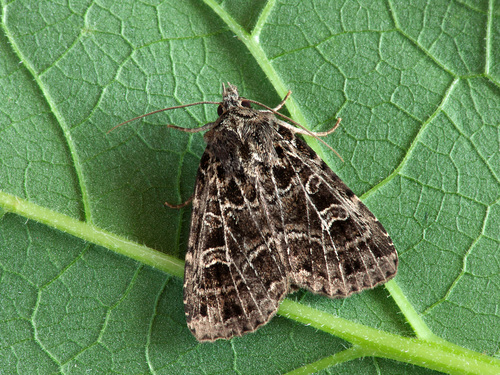
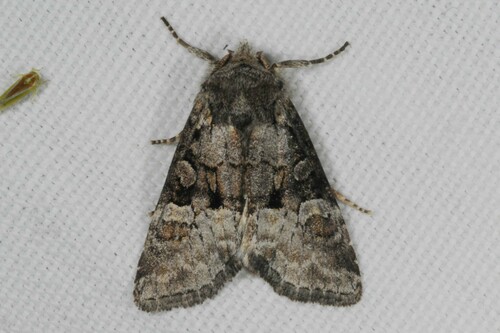
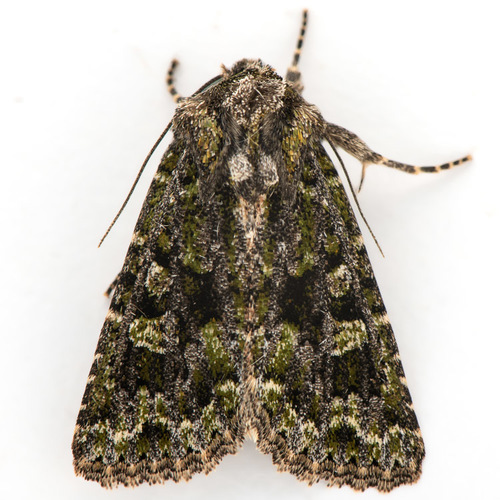
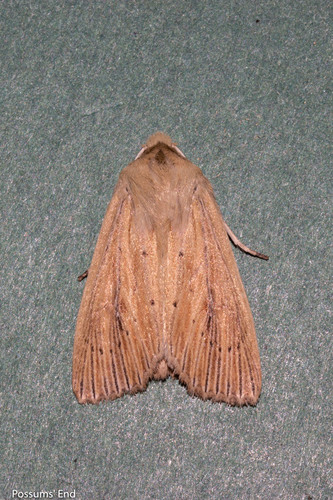
Meyrick originally described adults of this species as follows: For both males and females, the wingspan is 39–42 mm. The thorax has a moderate crest on its anterior end; no submedian streak can be detected. The cilia of the forewings are whitish-ochreous, sprinkled with fuscous and blackish scales; the cilia of the hindwings are white, with faint indications of a grey line. All other features match those of L. aulacias. Hudson gave an alternative adult description: The wing expansion is approximately 1+1⁄2 inches. Forewings are cream-coloured, with veins finely marked in grey; darker cream streaks run between the veins, and a row of minute black dots sits near the termen. The forewing cilia are cream-coloured. Hindwings are dark grey with white cilia.
This species is variable in appearance, and Hoare described three forms: the "typical" form, a "northern dark" form, and a "swamp" form. For the typical form, adult males have a wingspan of 31–41 mm, while adult females have a wingspan of 35–46 mm. For the northern dark form, males have a wingspan of 40–45 mm, and females have a wingspan of 41–44 mm. The swamp form is smaller: males have a wingspan of 33–37 mm, and females have a wingspan of 31–32 mm. Hoare hypothesised that this variability may indicate the species is currently evolving into several distinct species. However, while the forms differ in appearance, they show no differences in antennae or genitalia, so as of 2019 they are not considered separate species.
I. arotis can be confused with I. blenheimensis, I. theobroma, I. epiastra, and female I. arotis can also be confused with female I. cornuta. I. blenheimensis can be distinguished by its blackish forewing fringes, which I. arotis lacks, even when I. blenheimensis is worn and pale. I. theobroma may be confused with the northern dark form of I. arotis, but can be told apart as I. theobroma has broader wings and lacks the pale forewing markings present on the northern dark form of I. arotis. I. epiastra can be distinguished by its obvious row of black dots along the outer wing margin; I. arotis either lacks these marks entirely or has brown dashes in this position. Female I. arotis can be distinguished from female I. cornuta because I. arotis normally has dark scales on the thorax.
This species is endemic to New Zealand. It is found throughout the North and South Islands, but has not yet been recorded on Stewart Island.