About Icaricia acmon
Icaricia acmon, commonly known as the Acmon blue, is a butterfly species native to North America. Its distribution is centered mainly in California and Oregon, but it can also be found in southwestern Canada and the Great Plains Region of the United States. The total extent of its range is approximately 2,500,000 square kilometers. Due to its large range, the species occupies a variety of different habitats, including grasslands, fields, shrublands, forests, and deserts.
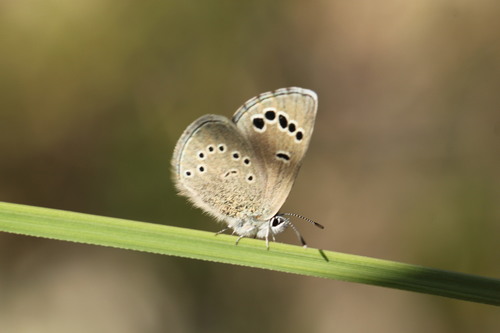
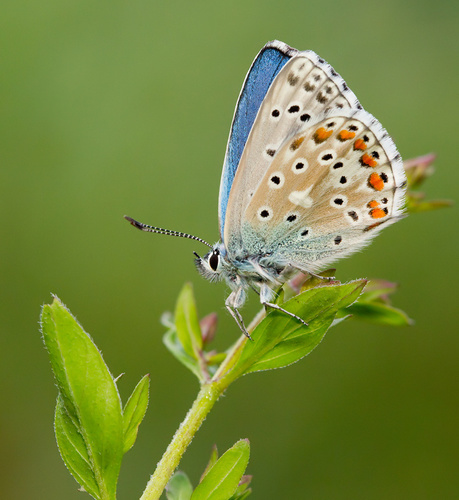
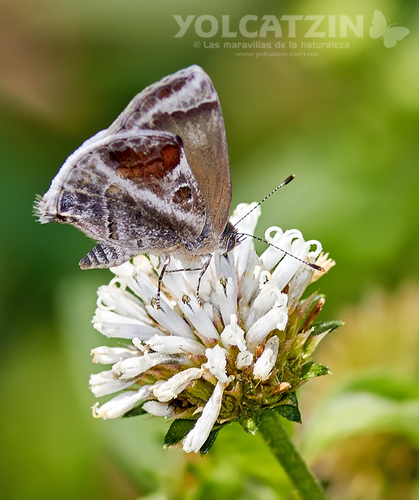
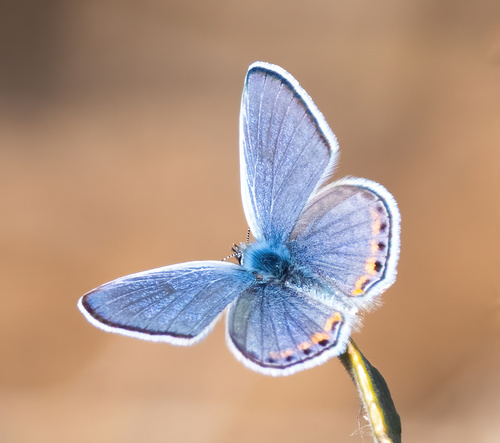
The Acmon blue was first discovered by Pierre Lorquin in 1850, when he visited California during the Gold Rush. It is thought that the discovery took place in the San Francisco area. The wingspan of adult Acmon blue butterflies ranges from 17 to 30 mm. On the upper surface of the wings, males are blue with dark edges, while females are brown. For both sexes, the underside of the wings is white with black spots, and has a red-orange band along the hindwing.
Caterpillars of this species are yellow, covered in white hairs, and have a green stripe running down the back. The species is richly colored; females in particular have contrasting rows of red lunules, which may sometimes fuse into a single band. Male hindwing lunules often turn pink, and may disappear entirely during the autumn season. Like many other lycaenid butterflies, the Acmon blue shares a mutualistic relationship with ants. Ants protect Acmon blue larvae, and in exchange, the larvae secrete honeydew that the ants consume.