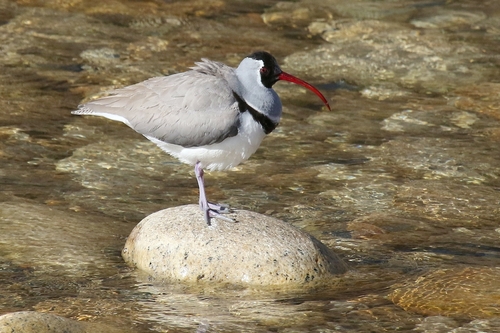
About Ibidorhyncha struthersii Vigors, 1832
Species Overview
The ibisbill (Ibidorhyncha struthersii) is 38–41 cm (15–16 in) long and has a highly distinct appearance.
Adult Plumage
Adults have grey plumage overall, with a white belly, a long, down-curved crimson bill that resembles the bill of the unrelated ibis, plus a black face and a black breast band.
Age and Sex Plumage Differences
Males and females look very similar, but juvenile birds lack the black markings on the face and breast, and their bills are duller in color.
Bill Measurements
The ibisbill's bill measures 6.8–8.2 cm (2.7–3.2 in) long, and is slightly longer in females than in males.
Leg Color Variation
Leg color varies by age and breeding status: breeding adults have greyish purple legs, juveniles have dull sepia legs, and younger or non-breeding adults have greenish legs.
Post-Mortem Leg Color Change
Shortly after death, the legs of deceased ibisbills turn crimson, the same shade as the species' bill.
Tarsus Characteristics
The tarsus is short and reticulated.
Toe Structure
Ibisbills have only three toes, and lack a hind toe.
Toe Webbing
A small, indleted web connects the outer and middle toes, while there is no webbing between the middle and inner toes.
Weight Measurements
This species typically weighs 270–320 g (9.5–11.3 oz), and females are slightly heavier than males.
Camouflage Ability
Despite its striking appearance, the ibisbill is hard to spot against its stony natural habitat.
Vocalization
Its call is a ringing klew-klew, similar to the call of a greenshank.
Flight Silhouette
When in flight, its outstretched neck and rounded wings give it an ibis-like silhouette.
General Distribution Range
Ibisbills are common across Central Asia and the Himalayas, ranging from Lake Issyk-Kul to the southern border of Manchuria, and also occur in the Altai region of Russia.
Kazakhstan Distribution
They also inhabit the highlands of the Central and Northern Tien Shan, and within Kazakhstan they live along the valleys of the Bolshaya Almatinka, Malaya Almatinka, Chilik, Issyk, Karkara, Bayankol, Dzhungar Alatau, and Choldysu rivers.
Breeding Elevation Range
The ibisbill breeds across southern Central Asia on stony riverbeds, usually at elevations between 1,700 and 4,400 m (5,600 and 14,400 ft), though there are confirmed records of ibisbills breeding as low as 500 m (1,600 ft).
Non-Breeding Elevation Range
Outside of the breeding season, ibisbills may descend to elevations as low as 100 m (330 ft).
Habitat Substrate Characteristics
They typically occupy shingle-bed river valleys between 100 and 1,500 m (330 and 4,920 ft) in elevation that have patches of sand and silt mixed with pebbles and small boulders.
Habitat Terrain and Vegetation
The river valleys ibisbills frequent usually have very little vegetation and gentle slopes that produce slow-moving water.
Habitat Limitation Factor
The species must live near slow-flowing water to feed, which limits its available habitat despite its large overall range.


