About Hypoponera punctatissima (Roger, 1859)
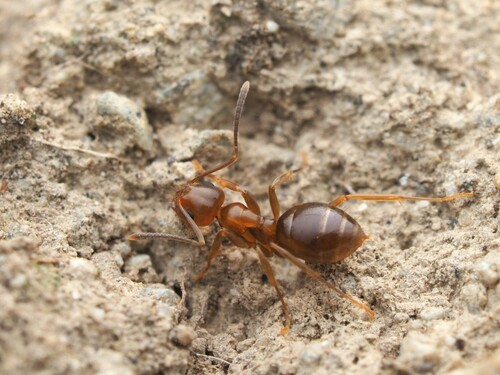
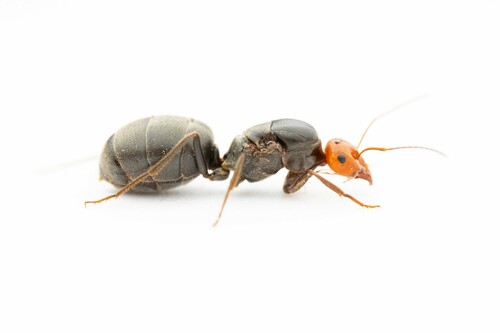
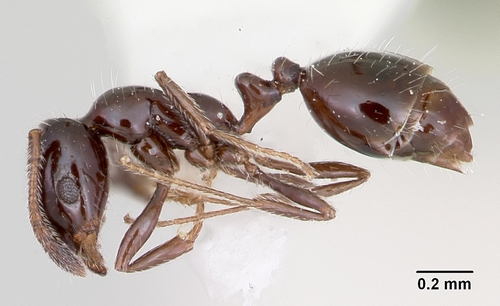
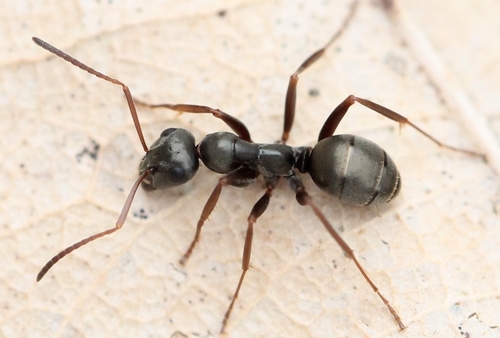
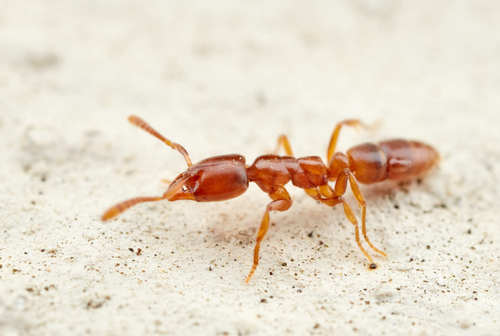
Hypoponera punctatissima (Roger, 1859) is a species of ant. Worker individuals are yellowish-brown to dark brown, and measure 2.5-3.2mm in length. The body and head are covered in short, stiff setae. This ant has triangular mandibles, and antennae that have a total of 12 segments. As a member of the subfamily Ponerinae, it has a single-segmented petiole, which is a shared trait of all members of this subfamily. A constriction is present between the first two segments of the gaster, and these two segments are more than twice as long as the remaining segments. Larger individuals within the species' size range tend to be darker in color, while smaller individuals tend to be lighter and more yellowish, but this correlation is not very consistent. Queens of this species are very similar to workers, but they are slightly larger, measuring 3.5-3.8mm. They bear wings for flight and also have remnants of their enlarged wing muscles. Ergatoid males of this species fall into two distinct groups: the first group is smaller, yellower, and lacks eyes, while the second is larger, darker, and retains functional eyes. Alate males have never been observed, and are assumed not to exist in this species. Males are typically slightly smaller than queens but larger than workers, and measure 3.4-3.6mm. Hypoponera punctatissima is a tramp species that has spread to many countries outside of its native range. It is native to the Gulf of Guinea region, Kenya, Uganda, Rwanda, Tanzania, much of southern Africa including Angola, Zambia, Mozambique, Botswana, and South Africa, and its native range extends north to Egypt, Sudan, Ethiopia, the Central African Republic, and the DRC. Outside of its native range, this species is considered invasive across much of Western Europe, some southern U.S. states, California, much of the Middle East, the Yucatán Peninsula, Panama, and Venezuela. It is also present in New Zealand, northern Australia, the island of New Guinea, Sri Lanka, Madagascar, and the Philippines, with scattered populations across other tropical regions. In much of Eastern and Northern Europe, Ireland, parts of southern Canada, some northern U.S. states, and areas of central Russia, the species is restricted to heated buildings and greenhouses. In its introduced range, it typically occupies heated buildings and outdoor heated habitats such as animal waste and fermenting waste.