About Hypolimnas bolina (Linnaeus, 1758)
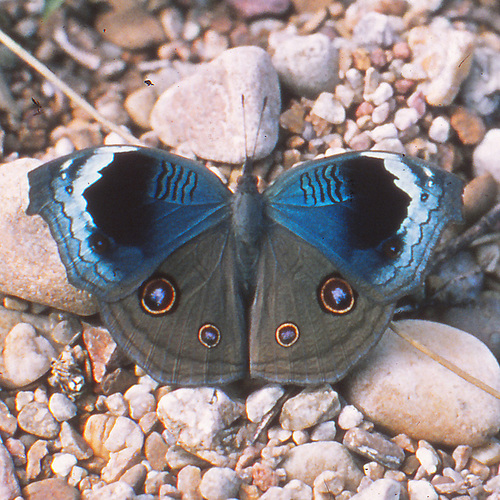
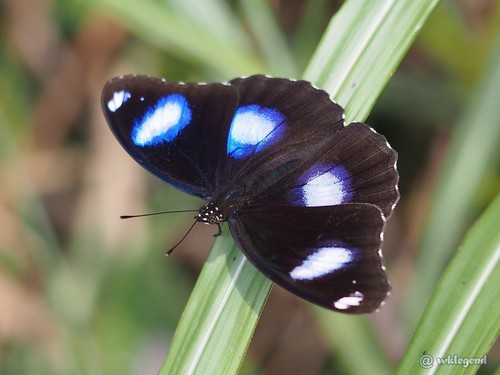
Hypolimnas bolina (Linnaeus, 1758), commonly called the great eggfly, common eggfly, varied eggfly, or blue moon butterfly in New Zealand, is a species of nymphalid butterfly. Its distribution extends from Madagascar in the west, through South and Southeast Asia including Cambodia, to South Pacific islands including French Polynesia, Tonga, Tuvalu, Samoa, Vanuatu, and Fiji. It also occurs in parts of Australia as far south as Victoria during summer and autumn, as well as in Japan, Taiwan, and New Zealand. Sightings in New Zealand are linked to favourable winds during the April–June migratory period in Australia. The species was first recorded in New Zealand in 1956, with further records in 1971 and 1995, and iNaturalist has records for New Zealand for every year since 2013. No established local populations exist in New Zealand. H. bolina is generally common across most tropical and subtropical habitat types, including wet and dry woodland such as tropical savanna, rainforest, and shrubland. It is a common visitor to suburban back yards and other areas disturbed by humans. In the Australian tropics, it is particularly common along tracks, streambeds, and corridors between remnant gallery forest and cultivated sugar cane fields. Both sexes are always found associated with one or more larval hostplant species, especially disturbance species such as Synedrella nodiflora, Sida rhombifolia, and Commelina cyanea. Males of this species are notably territorial. Individuals can return to defend the same location for up to 54 days, and site fidelity increases as individuals age. Males prefer territories that improve their ability to visually detect adult females, and they primarily use a sit-and-wait strategy to find potential mates. In southern areas, females are usually found gliding close to the ground. Unlike females of H. alimena, female H. bolina have a strong preference for exaggerated visual signals, specifically dorsal blue coloration. Unlike related species such as Hypolimnas anomala, female H. bolina most often lay one or two eggs at a time, typically on the underside of leaves. Early season (post-diapause) females in Australia's wet-dry tropics target freshly germinated seedlings of Synedrella nodiflora, their favoured host in this region. At a constant incubation temperature of approximately 25 degrees C, eggs hatch after 3 days. Newly hatched larvae first consume their egg shell before feeding on the leaf they were laid on. Later larval instars are highly mobile and readily disperse to find new host foliage. Individuals rarely pupate on their host plant or in its immediate vicinity.