About Hypolepis ambigua (A.Rich.) Brownsey & Chinnock
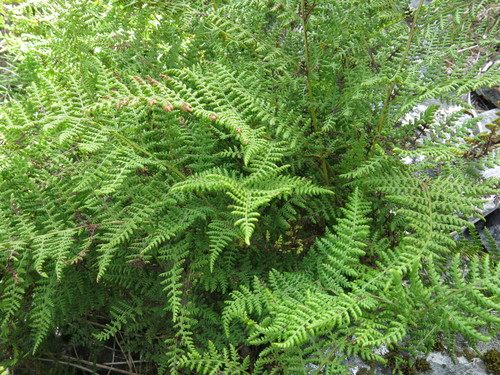
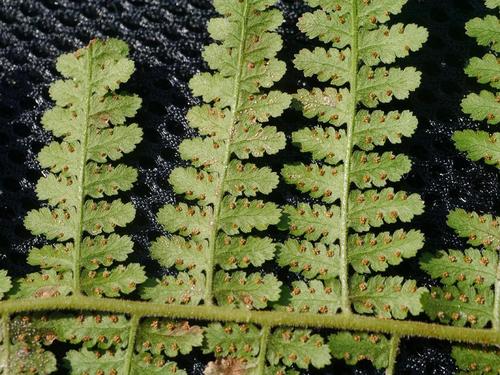
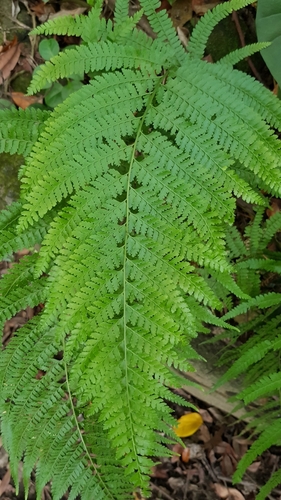
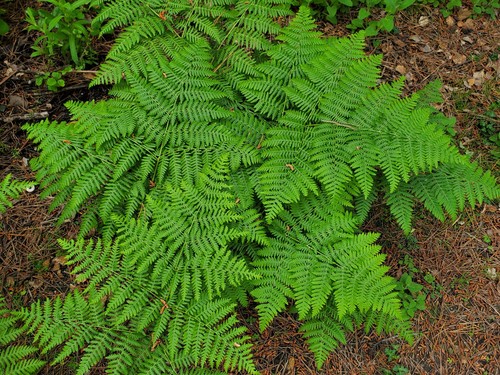
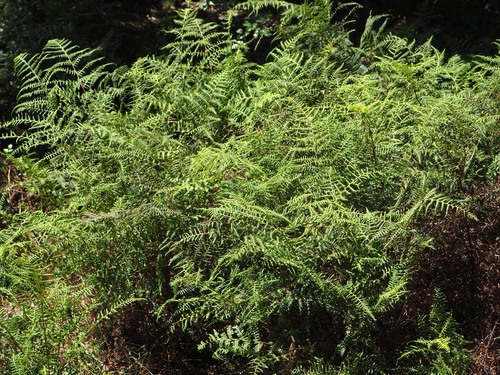
Hypolepis ambigua (A.Rich.) Brownsey & Chinnock is a fern native to New Zealand, with fronds that grow between 0.21 m and 1.85 m tall. It has long-creeping rhizomes covered in red-brown hairs, which produce new fronds at intervals of 20–200 mm. This growth pattern lets it form a ground cover similar to Pteridium esculentum. The primary pinnae (the frond's main leaflets) are largest at the base and get progressively smaller toward the frond's apex. Secondary and tertiary pinnae (sub-leaflets) are narrow; they may either decrease in size along the primary pinna, or retain a more consistent oblong shape. Its reproductive structures, called sori, are roughly round and protected by flaps of the leaf lamina. The structure of these sori is characteristic of the genus Hypolepis (from Latin hypo meaning under, and lepis meaning scale). Hypolepis ambigua is most often confused with Hypolepis dickinsioides, but unlike H. dickinsioides, it does not have sticky glandular hairs. This species is native to New Zealand's North Island, South Island, Three Kings Islands, Chatham Islands, and Stewart Island. On the North Island, it occurs in lowland to lower montane areas across Northland, Auckland, Taranaki, Volcanic Plateau, Gisborne, and the southern part of the island. On the South Island, it is found in nearly all coastal regions with the exception of eastern Otago. It is less common inland, and is not often found in southern Canterbury and central Otago. It has become naturalized non-natively on the island of Bute in Scotland. Hypolepis ambigua is a lowland species that prefers growing in open areas. It is most commonly found at bush margins, in forest clearings, open grassland, open forest, and scrub. Thanks to its fast-growing rhizomes, it often forms large colonies. Because it grows well on disturbed soil, it is also frequently found in urban areas. As a member of the class Polypodiopsida, Hypolepis ambigua shares the standard fern life cycle of alternation between the sporophyte and gametophyte generations. No specific research has been published on the phenology of H. ambigua, but most ferns are perennial, reproduce multiple times after reaching maturity, and reproduce seasonally. As a herbaceous fern, H. ambigua becomes fertile after one year of growth and stays fertile for the rest of its life. In winter, some of its older fronds die back, and new fiddleheads emerge in spring.