About Hypolaena fastigiata R.Br.
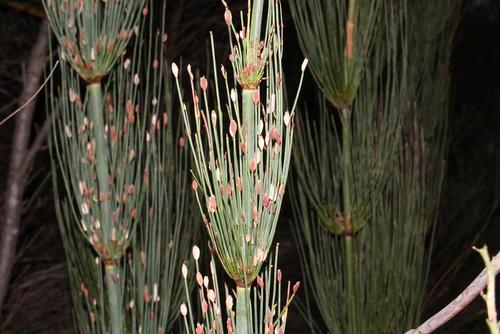
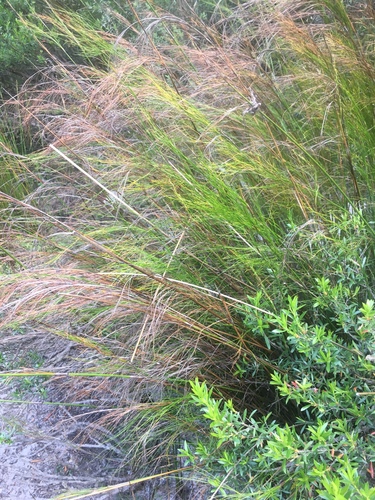
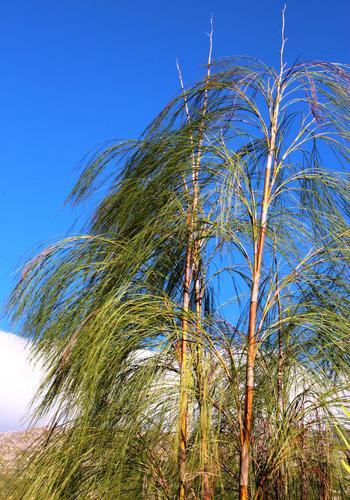
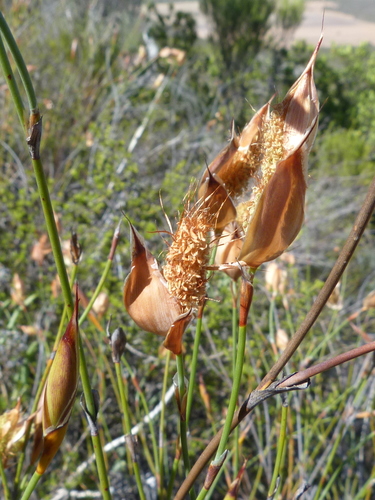
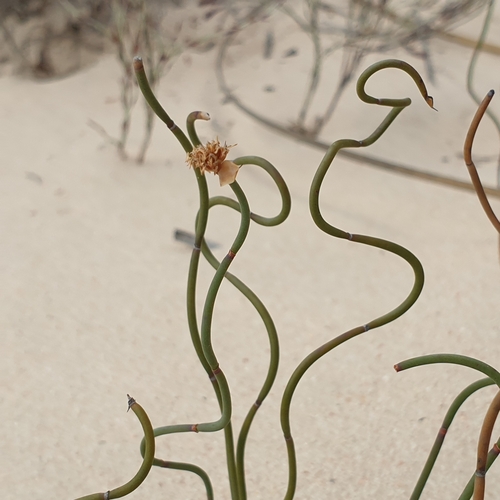
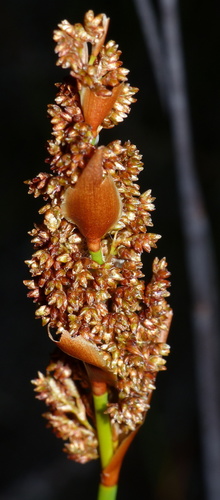
Hypolaena fastigiata is a perennial, dioecious herb that spreads via rhizomes, forming diffuse patches up to 2 meters across. Culms growing from the rhizomes are typically straight, sinuous, or flexuous, measure 20 to 60 cm long, and can be very highly branched. They are round in cross-section, 1 to 2 mm in diameter, and glaucous in color. Leaves along the culms are reduced to dark brown scales covered in brown pubescence. At the base of the culms, brown erect sheaths are closely spaced and around 1.5 cm long. The spikelets of Hypolaena fastigiata are characteristically dark brown-red in color. Male spikelets are pedicellate, occur singly or in clusters on the upper nodes of culms, are covered in whitish hairs, and range in shape from cylindrical to elliptical or obovoid. They are 2 to 3 mm long and hold 15 to 20 glumes. Male flowers have long stamens around 1.2 mm long. Female spikelets are sessile, terminal, and solitary on the uppermost nodes of the culms. They are erect, narrow-cylindrical, glabrous, and 6 to 15 mm long. Female flowers have tepals less than 1 mm in length, another diagnostic feature of the species. Hypolaena fastigiata flowers year-round, with peak flowering from August to December. Its fruit is an ovoid nut with a woody pericarp, measuring 2 to 4.5 mm in length. Hypolaena fastigiata is native to Australia, and is widespread across Tasmania, southern Queensland, New South Wales, Victoria, Western Australia, and South Australia. It is the only species in the Hypolaena genus that occurs outside of Western Australia. It has a fairly broad habitat range, and most commonly grows in damp or moderately dry sandy soils in heathland, peatland, or along swamp margins. It is widespread in coastal heathlands and wallums, and also occurs inland in areas where peatlands are present, particularly in Tasmania where peat sits above sandy soil. Because Hypolaena fastigiata grows in a rhizomatous pattern, it can form dense clumps with extensive root masses that can reach up to 2 meters across. This growth habit helps to stabilize soil structure, especially in the sandy soils where the species typically grows. Its rhizomatous root system also allows it to resprout after fires, which is very important for habitat regeneration after disturbance. It is also a facultative seeder, which further supports regeneration after fire. Research has found that Hypolaena fastigiata is sensitive to changes in soil moisture in terms of its water relations, so it can be used as an indicator of ecosystem health. The dense clusters of culms formed by H. fastigiata also provide habitat for many ground-dwelling mammals, and have been recorded as nesting sites for ground parrots.